Delivering Nursing Education in Thunder Bay, Ontario: A Perspective of Learning and Connection
As pediatric oncology nurses working across Ontario, we share a deep commitment to advancing care for children with cancer. Representing three distinct institutions, we bring together a blend of clinical expertise, Satellite clinic experience, and case management insight. In March 2025, we had the opportunity to travel to Thunder Bay Regional Health Sciences Centre (TBRHSC) to deliver nursing education, including the Association of Pediatric Hematology/Oncology Nurses (APHON) Pediatric Chemotherapy and Biotherapy Provider course, in preparation for the launch of the POGO Satellite Clinic and POGO Interlink program.

The teaching experience itself was rewarding on many levels. As instructors, it was a chance not only to teach but also to learn from one another. Each of us brought unique perspectives: Kirsty shared a wealth of clinical expertise and knowledge of Satellite care; Kyt contributed deep insights from his extensive background across nearly every pediatric oncology nursing role; and Diana represented one of Thunder Bay’s main referring centres. Observing each other’s teaching styles highlighted both the common ground we share and the distinct approaches that shape our practice.
In addition to the Chemotherapy/Biotherapy course, we delivered two full days of targeted education, to four enthusiastic clinic nurses, on key pediatric oncology topics, including bone marrow suppression, treatment side effect management, fever/neutropenia and sepsis, supportive care, and oncologic emergencies. Some of these topics were identified by the Thunder Bay team (Amy Halvorsen, Manager of Pediatrics, and Nicole Zuefle, POGO Interlink Nurse and Satellite Nurse Coordinator) as areas where additional education was needed. Hands-on learning in central venous line care, port accessing, and closed-system transfer device use provided valuable practical experience. The strong attendance from nurses, physicians, and learners reflected the Thunder Bay team’s dedication and commitment to advancing care.
 The trip also offered perspective. Experiencing the distance firsthand underscored the challenges families face when traveling for treatment. The POGO Satellite Clinic at TBRHSC will help ease that burden, allowing children and families to receive care closer to home. This reinforced an important truth: across the province, dedicated pediatric oncology nurses provide specialized care every day. Each individual effort contributes to something greater — a shared commitment to supporting children and families facing cancer.
It was a privilege to meet the TBRHSC nurses and welcome them officially to the POGO family. Their enthusiasm, expertise, and pride in their space were inspiring. Having connected with them in person, it feels especially meaningful when we now send patients their way.
Outside of work, we had time to explore Thunder Bay together. We visited the Terry Fox monument, Kakabeka Falls (“the Falls of the North”), the Sleeping Giant, and enjoyed local cuisine. Weather delays stretched our trip by an extra day — yet another reminder of how travel challenges can impact families seeking treatment. And, from the moment we arrived, it was clear that the local Indigenous culture was thoughtfully woven into the hospital environment. Parking lots were named after animals of spiritual significance, and we learned about the hospital’s Spiritual Care Team, which offers patients and families traditional practices such as smudging. This integration of culture into care was both meaningful and inspiring to see.
The TBRHSC nurses sent us off with a sweet farewell: a box of their famous Persian doughnuts. It was the perfect ending to a trip filled with learning, connection, and shared purpose.
This story was written for the fall 2025 issue of The RePORTer, POGO’s Nursing Newsletter by: Diana Masse, RN, Nurse Case Manager Children’s Hospital, London Health Sciences Centre, Kirsty Morelli, NP, Satellite Nurse Coordinator, Scarborough Health Network, Kaniska Young-Tai (Kyt), RN, Satellite Nurse Coordinator SickKids

Facing Stage 4 Cancer at Just Two Months Old
By Ruveena Mariathas
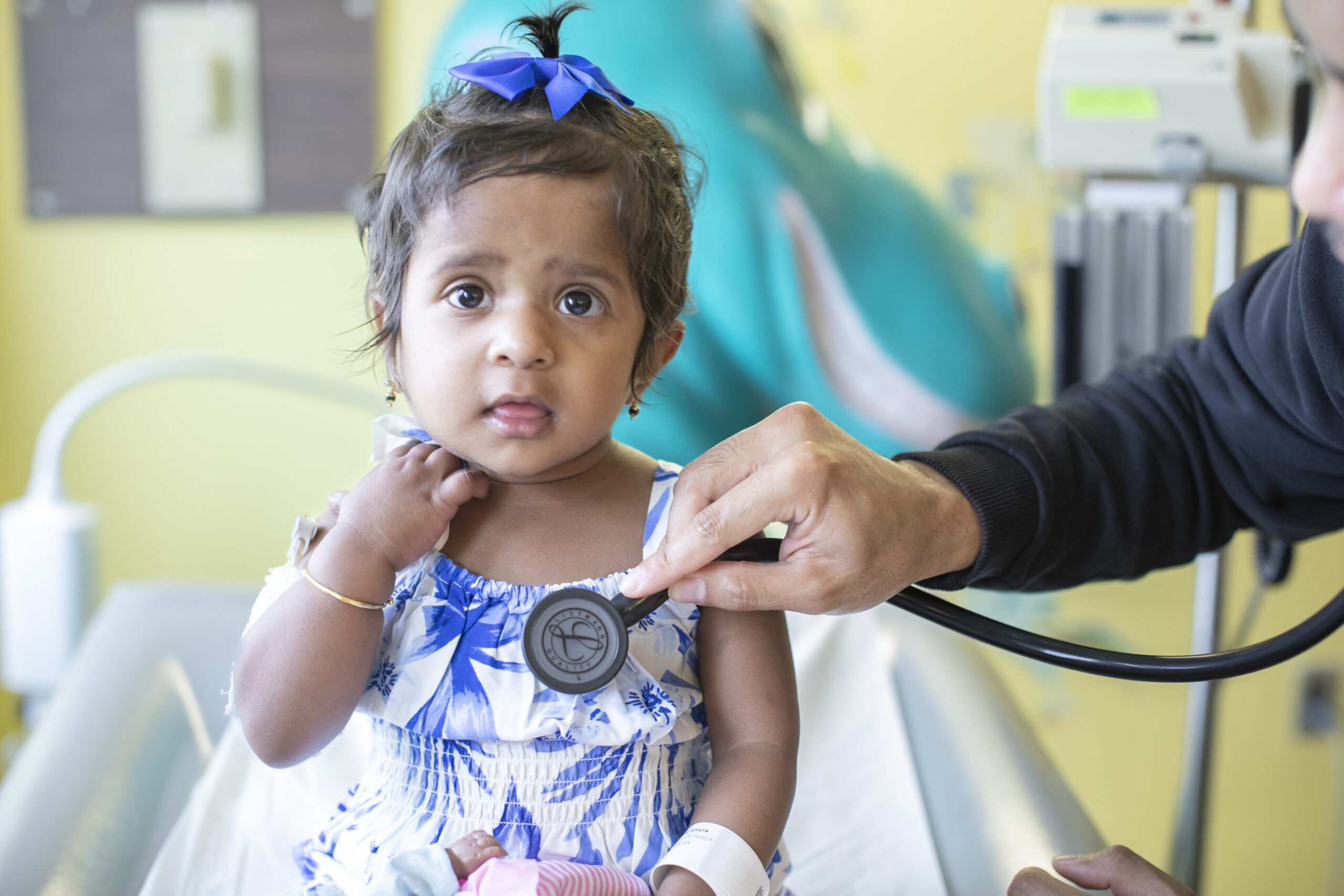
When Mallika was born, we thought she was just a fussy baby. She cried every night, and we took turns holding her upright while sleeping on the couch. Several visits to walk-in clinics indicated she had colic. But when she stopped having wet diapers and bowel movements, we knew it was something
more serious.
At just two months old Mallika was diagnosed with stage 4 rhabdomyosarcoma. Her treatment began almost immediately—aggressive chemotherapy that had us constantly travelling to downtown Toronto, me with no income and bills piling up.
Our POGO Interlink Nurse connected us to POGO’s Financial Assistance Program and handled the paperwork during a time when everything felt overwhelming. On her regular visits to our home, she always took time to check in o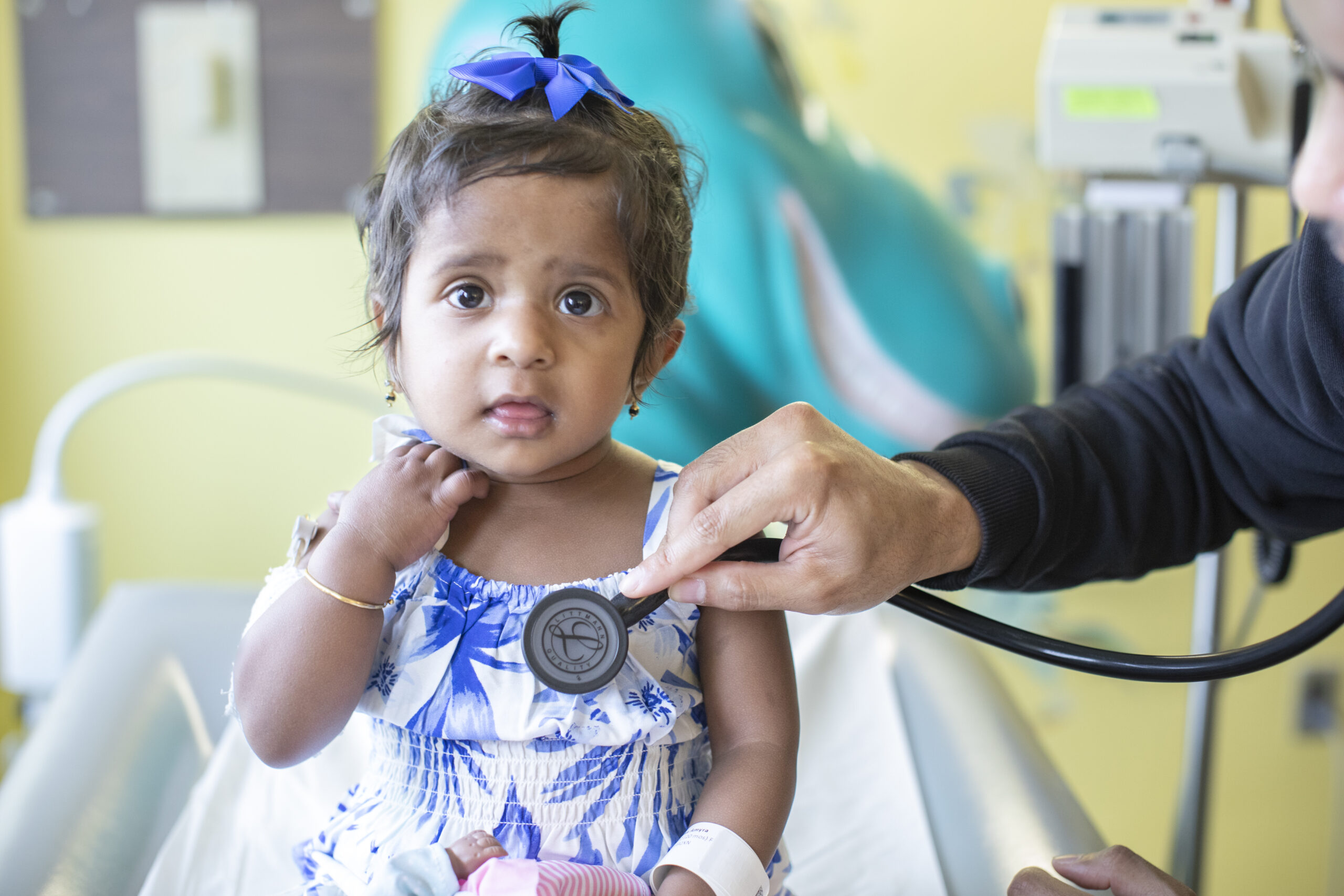 n our older daughter, Ashwana, to make sure she was coping with her sister being sick and her parents being away so often at the hospital.
Eventually, we were able to move part of Mallika’s care to the POGO Satellite Clinic at Scarborough Health Network. Being close to home meant we could sleep in our own beds, spend more time with Ashwana, and bring Mallika in for her daily chemotherapy without the added pressure of a long commute. The Satellite Clinic is a warm and welcoming environment, and the nurses became like family—they knew her well, noticed small changes and helped us through some scary moments, including a serious episode of dehydration.
Mallika has had surgery to remove her bladder and now needs daily catheterization, which means we have to use a tube to keep her wounds from closing. When she turns five, doctors plan to create a neobladder—a surgically constructed bladder to help restore some normal function. Despite all she’s faced, she’s full of energy and steadily catching up on her milestones.
Mallika rang the bell at the clinic to mark the end of treatment. Our POGO nurse cried. We cried. After everything we’d been through, it felt like we could finally breathe.

Childhood Cancer Care Expanded to Northwestern Ontario
POGO Satellite and Interlink Programs Bring Childhood Cancer Care Closer to Home
at Thunder Bay Regional Health Sciences Centre
Thunder Bay, ON, June 4, 2025 – Today, childhood cancer care closer to home became a reality for families living in Northwestern Ontario with the launch of two new Pediatric Oncology Group of Ontario (POGO) programs at Thunder Bay Regional Health Sciences Centre (TBRHSC). Expansion of the POGO Satellite and Interlink Nursing programs at TBRHSC was made possible thanks to funding from Ontario’s Ministry of Health.
For childhood cancer patients and their families in the Northwest, much of their care is provided at Children’s Hospital at London Health Sciences Centre. The establishment of the POGO programs at TBRHSC means fewer trips to London and more time at home with their support network of family and friends and less disruption to school and work.
“It was important for us to be at Thunder Bay Regional for the launch of these POGO programs,” said Drago and Shanley Pavletic of Thunder Bay, whose son was treated at Children’s Hospital at London Health Sciences Centre. “We know firsthand what it means to be away from home while our child was in treatment. Now, parents won’t always have to leave their jobs or split their families apart. You can’t put a price on that kind of peace of mind.”
POGO now coordinates childhood cancer care at nine Satellite Clinics in community hospitals across the province. The multidisciplinary healthcare team in the POGO Clinic at TBRHSC includes doctors, nurses, child life specialists, and social workers, and provides a range of high-quality pediatric cancer services.
The POGO Interlink Nurse will be assigned to families at diagnosis, connecting them to services they need, whether in the hospital or community. The POGO Interlink Nurse may also visit the child’s school to share information about the child’s cancer journey with teachers and the child’s or their sibling’s classmates.
“POGO programs provide wrap-around care and support to children and families from diagnosis to treatment to survivorship, and, when needed, end-of-life care,” said Lauren Ettin, POGO CEO. “Expansion of the POGO Satellite Clinic and Interlink programs to Thunder Bay Regional Health Sciences Centre signals meaningful change for local families and fulfills an important objective of Ontario’s five-year Childhood Cancer Care Plan, to bring care closer to home. We are honoured to partner with the incredible teams at Thunder Bay Regional Health Sciences Centre and Children’s Hospital at London Health Sciences Centre to meet the needs of children with cancer and their families in Northwestern Ontario.”
“We are proud to join the Pediatric Oncology Group of Ontario (POGO) as an official Satellite Clinic,” said Dr. Rhonda Crocker Ellacott, President and CEO of Thunder Bay Regional Health Sciences Centre (TBRHSC) and CEO of the Thunder Bay Regional Health Research Institute (TBRHRI). “This designation marks a significant step forward in enhancing the quality of care for children and families facing cancer in Northwestern Ontario. Through this partnership with POGO and the Children’s Hospital at London Health Sciences Centre, we will be able to offer more comprehensive and coordinated care closer to home. Our interdisciplinary teams, including a dedicated Interlink Nurse, will guide families through every stage of the pediatric cancer journey—reducing travel burdens, supporting continuity of care, and helping to improve health outcomes. Most importantly, children can now receive specialized treatment right here in Thunder Bay, enabling families to remain together during a challenging time.”
“The launch of the POGO Satellite and Interlink programs at Thunder Bay Regional Health Sciences Centre is a significant milestone for childhood cancer care in Northwestern Ontario,” said Dr. Alexandra Zorzi, head of paediatric hematology and oncology at Children’s Hospital at London Health Sciences Centre (LHSC). “At Children’s Hospital, we are dedicated to extending our specialized care and support to families in this region. By bringing these vital services closer to home, we help to ensure our young patients receive the same high-quality care they would at Children’s Hospital, but within their own community. This initiative not only alleviates the physical and emotional strain on families, but also strengthens our mission to provide comprehensive, patient-centered care across the region.”
In video remarks, Minister of Health Sylvia Jones spoke on behalf of Premier Ford and the entire government saying, “I would like to congratulate the Pediatric Oncology Group of Ontario, along with Thunder Bay Regional Health Sciences Centre and Children's Hospital at London Health Sciences Centre, as you launch your POGO Satellite Clinic in Thunder Bay. This marks an important milestone with the expansion of world-class childhood cancer care in Northwestern Ontario. Thank you again to POGO and all your partners for everything you do to support children impacted by childhood cancer and their family.”
About Pediatric Oncology Group of Ontario (POGO)
Pediatric Oncology Group of Ontario (POGO) works to ensure that everyone affected by childhood cancer has access to the best care and support. POGO partners to achieve an excellent childhood cancer care system for children, youth, survivors, and their families and healthcare teams, in Ontario and beyond. POGO champions childhood cancer care, and as the collective voice of this community, is the official advisor to Ontario’s Ministry of Health on children’s cancer control and treatment. POGO is a non-profit organization with charitable status, here for kids with cancer, for now, for life.
About Thunder Bay Regional Health Sciences Centre (TBRHSC)
Thunder Bay Regional Health Sciences Centre (TBRHSC), a 425-bed academic specialized acute care facility, is a national leader in Patient and Family Centred Care. As the only tertiary care provider in Northwestern Ontario, we provide comprehensive services to a population of over 250,000 residents in a region the size of France. Effectively addressing the health care needs of patients and families has earned us both Innovation Awards and Leading Practice Designations. As an academic health sciences centre, we teach the next generation of health care providers and advance medical research. Patients benefit from interprofessional teams of dedicated health care providers and access to leading-edge medical technology and clinical trials. To fulfill its teaching and research strategic goals, TBRHSC is supported by Thunder Bay Regional Health Research Institute (TBRHRI) as a not-for-profit and independent research corporation. TBRHRI is the research arm of TBRHSC and seeks to lead research to improve the health outcome of the people of Northwestern Ontario and beyond.
About London Health Sciences Centre
London Health Sciences Centre has been at the forefront of medicine in Canada for 145 years and offers the broadest range of specialized clinical services in Ontario. Building on the traditions of its founding hospitals to provide compassionate care in an academic teaching setting, London Health Sciences Centre is home to Children’s Hospital, University Hospital, Victoria Hospital, the Kidney Care Centre, two family medical centres, and two research institutes – Children’s Health Research Institute and Lawson Health Research Institute. As a leader in medical discovery and health research, London Health Sciences Centre has a history of over 65 international and national firsts and attracts top clinicians and researchers from around the world. As a regional referral centre, London Health Sciences Centre cares for the most medically complex patients including critically injured adults and children in southwestern Ontario and beyond. The hospital’s nearly 15,000 staff, physicians, students and volunteers provide care for more than one million patient visits a year. For more information visit www.lhsc.on.ca.

New POGO Clinic Helps Teen Stay Connected with Friends
In September 2018, at the launch of the new POGO Pediatric Oncology Satellite Clinic at Peterborough Regional Health Centre (PRHC), Theresa Serracino-Inglott, husband Mario and son Anthony spoke on behalf of the parents and young patients who will be receiving care. Last year in late August, Anthony was gearing up to start his Grade 11 year when he was diagnosed with acute lymphoblastic leukemia (ALL). Anthony spent most of his first six months at SickKids hospital because of complications and an extremely tough protocol for his high-risk diagnosis. Throughout the past year – and more so in the last six months – the Pediatric Outpatient or POP Clinic at PRHC has been our second home.
In April, Anthony was here for supportive care close to 20 days, and every day he was greeted with a smile and the exceptional care we have come to know from Shay Cannon and the POP Clinic Team. This was such a relief because as parents of children with a cancer diagnosis, we are continually being bombarded with difficult and gut-wrenching fears – and leaving the safety of SickKids Hospital is one of them.
Having to take your child to a new place for their care and allowing unfamiliar medical staff to provide treatment leaves us parents feeling vulnerable and scared – but once we walked through the doors of the POP Clinic and met Shay and the POP Clinic team, our fears subsided. Anthony immediately made a connection with the staff that has only strengthened over the months. Being closer to home to attend to such things as his fevers and blood work has meant a lot to Anthony. When he was admitted with a fever and had to stay at PRHC for more than a couple of days, it meant that his friends could easily come and keep him company to pass the time.
Throughout this time, the POP Clinic team was already beginning the transition to become an official POGO Satellite Clinic, which included staff training in all of the specialized areas of care we knew Anthony would need.
Now that this is an official POGO Satellite site, I can’t help but think of “future POGO families” in our area. Perhaps today, the news of the new clinic may not even register, but when they are burdened with their child’s diagnosis, they will have these things to ease their journey:
- Closer access to chemo treatments
- A “fever card” that is our direct route to the in-patient unit, allowing us to bypass emergency
- Coordinated care between PRHC and SickKids that meets the high standard of care that POGO Satellite Clinics deliver
- A trusting relationship with qualified staff that go above and beyond for patients in their care
- Support from other POGO families that become lifelong friends because of this journey they’ve shared together
Having a POGO Clinic close to us makes life as a parent a whole lot easier. Feeling financially strapped is a common thread among families of children with cancer and satellite clinics give some relief to that. The shorter distance helps us save money on gas for the car, the need to eat out, motel costs, and childcare needed for siblings.
Anthony has already benefitted from shorter clinic visits. This is important because as a teen with cancer, many occasions have been missed because of treatment. Having the accessibility of the POGO Clinic gets him back to his friends who play a very important part in his recovery.
Parents of children with cancer certainly would have never chosen this path for our children, but because this is where we find ourselves, I want to say how grateful we are to POGO and to Peterborough Regional Health Centre for making it possible for families like ours to have an official POGO Satellite Clinic right in our community. We can’t thank you enough for easing the burden by keeping many aspects of our child’s cancer treatment closer to home. Thank you.
Read the media release
Related Content

Peterborough Home to 8th POGO Satellite Clinic
New POGO Satellite Clinic brings care closer to home for children with cancer in Peterborough area
On Monday, September 24, the Pediatric Oncology (POGO) Satellite Clinic at Peterborough Regional Health Centre (PRHC) officially opened its doors to provide care for children with cancer right in their community.
For these patients and their families, care closer to home means a reduction in travel time, costs to receive care elsewhere are avoided, and less loss of income and separation from home and community, all while maintaining confidence that their child is receiving the best quality care.
“Having a POGO clinic close to us makes life as a parent a whole lot easier,” says Theresa Serracino-Inglott, whose son Anthony is currently receiving treatment at PRHC after being diagnosed with Acute Lymphoblastic Leukemia in August 2017. “Feeling financially strapped is a common thread among families of children with cancer, and these satellite clinics give some relief to that. I want to say how grateful we are to POGO and to Peterborough Regional Health Centre for taking on this partnership to bring a POGO Satellite Clinic to our community. I can’t help but think of future ‘POGO families’ in our area, and how the availability of this clinic will ease their journey.”
POGO now supports highly coordinated care at eight Satellite Clinics across the province, each linked to one of the five major hospitals with a pediatric cancer program. In addition to the benefits for patients and their families, shifting thousands of visits and hundreds of inpatient days to POGO Satellite Clinics each year provides additional capacity for specialized care in these hospitals’ pediatric cancer programs.