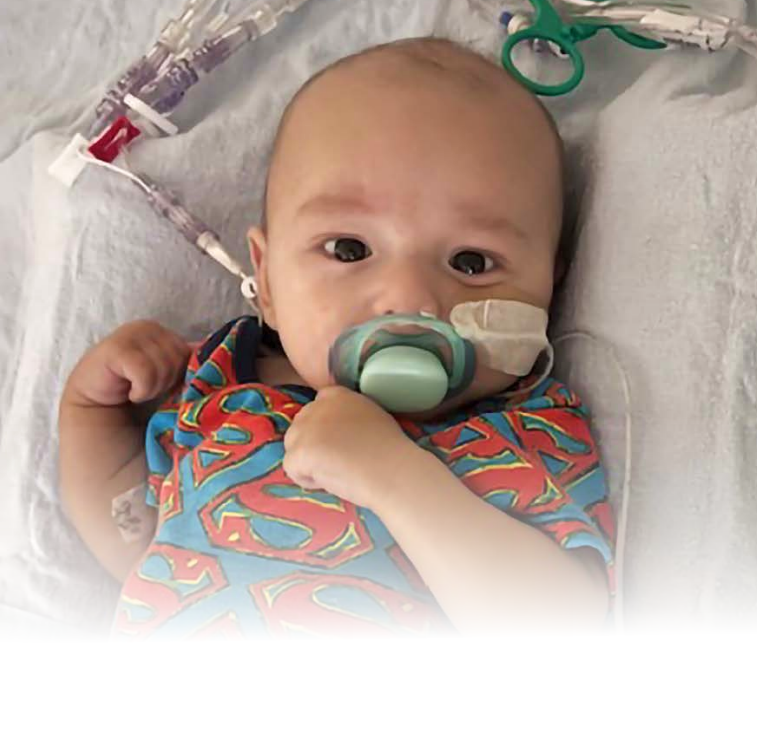
Bruce Power and supplier partners donate $100,000 to Pediatric Oncology Group of Ontario
Bruce Power and its supplier partners continue to support those impacted by childhood cancer by combining to donate $100,000 to the Pediatric Oncology Group of Ontario (POGO).
Bruce Power and supplier donations enable POGO to continue to build the best childhood cancer research and care systems for impacted youth and their families. POGO programs include financial assistance for families in need, transitions counselling and much needed continued research in the field.
“Through the generous commitment of Bruce Power and its Supplier Partners, we are making a meaningful difference in the childhood cancer community,” said Shannon Caskey, POGO’s Chief Development Officer. “Their investment enables us to extend our reach, innovate, and drive programs and services that benefit patients, survivors, families, and health care professionals throughout Ontario.”
Originally published on the Bruce Power website, September 25, 2024

Pat Dalzell, Bruce Power’s Vice-President of Corporate Affairs and Market Development, said the company and its partners are happy to be able to help.
“We are committed to supporting POGO with its impressive cancer care efforts. With cancer rates rising worldwide and its devastating impact on children and their families, we are proud to support an organization that provides impacted Ontario families with the care and comfort they need,” Dalzell said.
Bruce Power and its employees are also proud of their role as a global supplier of medical isotopes, which are used in various forms of cancer treatment and the sterilization of medical equipment.
About Bruce Power
Bruce Power is an electricity company based in Bruce County, Saugeen Ojibway Nation Territory, Ontario. We are powered by our people. Our 4,200 employees are the foundation of our accomplishments and are proud of the role they play in safely delivering clean, reliable nuclear power to families and businesses across the province and cancer-fighting medical isotopes around the world.

Congratulations to the 2024 POGO Recognition Awards Recipients
On Friday, November 8, the Pediatric Oncology Group of Ontario (POGO) honoured the recipients of the 2024 POGO Recognition Awards at a Celebratory Dinner. Established in 1999, the awards acknowledge significant contributions of Ontarians to the field of childhood cancer care in Ontario and beyond. Award recipients work in POGO partner hospitals and demonstrate POGO’s core values of partnership, collaboration and excellence.

POGO Champion Award
Lee Dupuis, RPh, PhD
Pediatric Oncologist, Senior Scientist, Professor, Division of Haematology/Oncology, The Hospital for Sick Children
In recognition of her dedication to improving the lives of childhood cancer patients, exceptional leadership in supportive care, and commitment to those she mentors and all with whom she collaborates, in Ontario and beyond.
POGO Visionary Award
Ian M. Wilson, MD
Pediatrician, Grand River Hospital
In recognition of his integral role in shaping the vision for the POGO Satellite Clinic Program, bringing childhood cancer care closer to home for families in communities across Ontario.
POGO Nursing Leadership Award
Tina Hamalainen, RN, BScN
POGO Interlink Team Leader, The Hospital for Sick Children
In recognition of her commitment to a patient-centred approach to childhood cancer care that improves the lives of young people and their families, and to a culture of learning in support of pediatric oncology teams.

POGO Community Partner Impact
The Slaight Family Foundation
In recognition of their exceptional and longstanding commitment to childhood cancer care, and landmark investment of $1,000,000 in the POGO School and Work Transitions Program.
Learn more about the POGO Recognition Awards Program

Premier Ford and Minister Jones join POGO to launch new roadmap to strengthen Ontario’s world-class childhood cancer care system
Ontario’s new five-year Childhood Cancer Care Plan, produced by the Pediatric Oncology Group of Ontario (POGO) and its partners, builds on strong, province-wide coordination to deliver wrap-around care and support for children, youth, survivors and families at every step of the childhood cancer journey.

September 23, 2024, Toronto, ON – Premier Doug Ford and Minister of Health Sylvia Jones recently joined POGO to launch the Childhood Cancer Care Plan: A Roadmap for Ontario 2024-2029. Published by POGO and its partners, the Plan leverages strong collaboration and coordination across the province to ensure wrap-around care and support for children and youth with cancer, survivors and families at every step of the childhood cancer journey. With support from the Government of Ontario, this new roadmap will continue to strengthen the province’s world-class childhood cancer system.
“Unfortunately, too many families here in Ontario are faced with the harsh reality of childhood cancers,” says Premier Doug Ford. “It's a terrible disease that impacts not just the children, but their entire family. We're incredibly grateful for the outstanding work that POGO does to support these families, ensuring they have access to the care they need, when and where they need it.”
“We thank POGO for your dedication, for your leadership and collaboration, for everything you do to support children and their families facing a cancer diagnosis,” says Health Minister Sylvia Jones. “I look forward to our continued work to ensure families have access to the best possible treatment and care throughout their journey.”
POGO works to ensure that everyone affected by childhood cancer has access to the best care and support. Informed by diverse voices from across the childhood cancer community, the Plan has priorities which focus on bringing care closer to home, ensuring survivor well-being, harnessing data, improving access to drugs and therapies, and enhancing the availability of mental health and financial supports for families.
Sam Taylor’s daughter, Ellie, was diagnosed with rhabdomyosarcoma, a soft tissue cancer, at age 10. “Shortly after Ellie’s diagnosis, we were connected with a POGO Interlink Nurse, an invaluable resource who guided us through the hospital system and helped us understand the unfamiliar world of childhood cancer,” says Sam Taylor. “Through her visits to our home and Ellie’s school, we knew we were in good hands. And when the time was right, the nurse helped us with the transition to care closer to home at the POGO Satellite Clinic at our local community hospital. This meant more time for Ellie with her friends and brother and a lot less time on the road. The POGO Satellite quickly became a second home for our family—an inviting place with an incredible staff where Ellie felt safe and relaxed, and where we, as her parents, felt reassured that she was receiving the best possible care.”
“Ontario’s childhood cancer care system is considered one of the best in the world, and we have the opportunity to make it even better by addressing current challenges and thinking ahead to navigate future demands,” says James Scongack, Chair of the POGO Board of Directors. “On behalf of POGO and our partners, I want to thank the Government of Ontario for its support, and its commitment to improving the lives of thousands of kids and families across Ontario dealing with this devastating disease.”
“There is exceptional pride in the quality and accessibility of Ontario’s childhood cancer care system. This is made possible by a shared vision of excellence across our incredible community,” says Lauren Ettin, Chief Executive Officer of POGO. “Working together, we can continue building on our collective success, so that children and youth with cancer, survivors and families can count on having the treatments, resources and supports they need, now – and for life.”
Download and share the Childhood Cancer Care Plan: A Roadmap for Ontario 2024-2029.
-30-


About Pediatric Oncology Group of Ontario (POGO)
Pediatric Oncology Group of Ontario (POGO) works to ensure that everyone affected by childhood cancer has access to the best care and support. We partner to achieve an excellent childhood cancer care system for children, youth, survivors, and their families and healthcare teams, in Ontario and beyond. POGO champions childhood cancer care, and as the collective voice of this community, is the official advisor to Ontario’s Ministry of Health on children’s cancer control and treatment. POGO is a non-profit organization with charitable status, here for kids with cancer, for now, for life.
Media Contact
Jacqui DeBique
Senior Manager, Communications
Pediatric Oncology Group of Ontario (POGO)
416-592-1232 ext. 266


Childhood Cancer is a Lifelong Journey
Appearing in Metroland publications, September 17, 2024
While more kids are being diagnosed with cancer, more are surviving. Ontario’s childhood cancer survival rate is now 85 per cent — up from about 70 per cent in the mid-1980s. And while surviving cancer is certainly the goal, the impacts of childhood cancer can last a lifetime.
Richard Lautens Toronto Star file photo
By Lauren Ettin and Dr. David Hodgson
Lauren Ettin is the chief executive officer of the Pediatric Oncology Group of Ontario. Dr. David Hodgson is the medical director and chair in childhood cancer control for the Pediatric Oncology Group of Ontario, a radiation oncologist and clinician scientist at the Princess Margaret Cancer Centre, and associate staff at The Hospital for Sick Children.
Life for the Pugliese family changed forever when six-year-old Giacomo was diagnosed with acute lymphoblastic leukemia. For three years, they made countless trips to McMaster Children’s Hospital, watching their once-energetic little boy endure the challenges of cancer treatment, with interruptions to school and play dates.
Now 17, Giacomo’s treatment is behind him, but he is monitored regularly at the Pediatric Oncology Group of Ontario (POGO) AfterCare Clinic at McMaster Children’s Hospital for secondary cancers and heart issues — risks from his cancer and treatment. The clinic staff also emphasize the importance of a healthy, active lifestyle. His family is reassured that Giacomo will receive this crucial care for the rest of his life.
POGO’s network of clinics across Ontario play a vital role in the ongoing care of childhood cancer survivors, becoming an essential part of their lifelong health journey.
September is Childhood Cancer Awareness Month, a time to spotlight stories like Giacomo’s, which are increasingly common in Ontario.
While more kids are being diagnosed with cancer, more are surviving. Ontario’s childhood cancer survival rate is now 85 per cent — up from about 70 per cent in the mid-1980s. This is thanks to decades of clinical innovation, improvements in diagnostics and treatments, and approaches to addressing some of the related side effects.
While surviving cancer is certainly the goal, it is not where the journey ends. The impacts of childhood cancer can last a lifetime.
Childhood cancers are distinct from adult cancers in significant ways. For one thing, these cancers don’t result from lifestyle or diet. They come suddenly — and some are more likely to strike at a specific age. Typically, childhood cancers require intensive treatments, at major teaching hospitals, with highly specialized protocols. Consequently, care teams may be larger and include parents and caregivers as key decision makers.
A childhood cancer diagnosis impacts the whole family. One parent is often forced to give up work to manage the daily practicalities of their child’s care. Often, extensive travel or temporary relocation is required, uprooting families for months or sometimes years. This disruption reverberates, impacting extended family members, friends, teachers, classmates, work colleagues and communities.
Childhood cancers strike during a critical phase of development, when children and adolescents are marking key physical, mental and social milestones. As a result, two of every three survivors are at increased risk of at least one long-term side effect resulting from their cancer or its treatment, including heart disease, second cancers and cognitive challenges.
To address the unique complexities, ripple effects and long-term impacts of childhood cancer, POGO and its partners have built a system that provides wraparound care and support for children and families at every stage of the journey. Considered among the best in the world, Ontario’s childhood cancer system goes beyond diagnosis and treatment. Families are paired with nurses who help navigate the transition from hospital to home, and they can also access mental health services, financial supports, and programs that help survivors thrive into adulthood.
During Childhood Cancer Awareness Month, it’s important to recognize the tremendous progress made in childhood cancer care. But there is more we can do to ensure kids not only survive, but thrive.
It is vital that children with cancer and their families have access to the best evidence-based treatments and supports, closer to home. This requires strong, ongoing collaboration between care teams, hospitals, nonprofits, government, regulatory bodies, industry and others.
Over the past decade, we have also seen an increasing need for mental health services, a need that is urgently felt among the many who are impacted by a childhood cancer diagnosis. These priorities and others will be key components of Ontario’s Childhood Cancer Care Plan 2024-2029, a road map developed by POGO and its partners to be published later this month.
Ontario must continue strengthening its world-class childhood cancer system so that survivors like Giacomo can count on having the treatments, resources and supports they need today — and for life.
Let's Raise Awareness of Childhood Cancer all Month Long
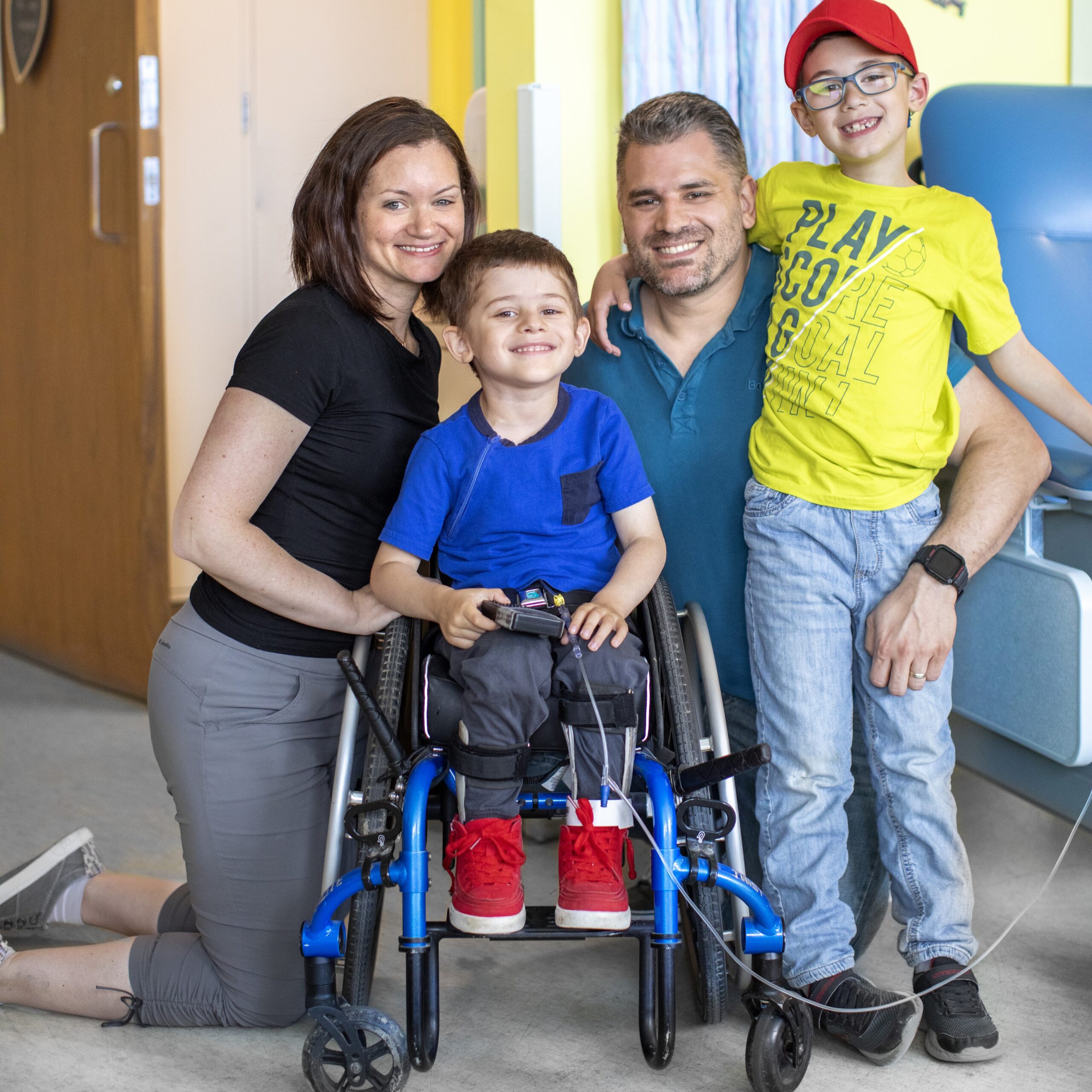
Meet the Funk family. When young Christopher was just a year old he was diagnosed with a spinal cord tumour. After an intense surgery and several months of chemotherapy, the family was relieved to move his treatment to a POGO Satellite Clinic closer to home, where he still receives weekly chemotherapy. This transition not only reduced the time his parents had to spend away from work but also allowed Christopher and his sibling, Alexander, to spend much more time together.
September is Childhood Cancer Awareness Month (CCAM). In Ontario and beyond, many are raising awareness of both the progress and ongoing challenges in childhood cancer care. Every day, POGO collaborates with hospitals, families, survivors, government, and donors to champion this cause.
Here’s how you can get involved:
GIVE
Support childhood cancer care by making a donation, becoming a monthly donor, learning more about legacy giving, or contributing in honour of someone affected by childhood cancer.
#LINKEDForLife Campaign
Vibrant paper chains will hang in the halls of POGO partner hospitals throughout Ontario, showcasing our collective commitment to support young cancer patients and their families, survivors, healthcare teams, and those who left us too soon. Donate to add your name and help grow our chain!
Get Your Company Involved
Engage your company with fun activities like office fundraisers, a pajama day, raffles, or building a #LINKEDForLife chain.
Register for an Event that Supports POGO
Stay active and support childhood cancer care by participating in the PUMA Toronto Women’s 8K/5K or the TCS Toronto Waterfront Marathon 5K in October. Register and fundraise for POGO.
Let’s work together to make a difference!
Related Content
POGO CEO Lauren Ettin Makes the Rounds

Since Lauren Ettin joined POGO as Chief Executive Officer in April 2024, she has been making the rounds, becoming familiar with the inner workings of POGO programs and services at our partner hospitals, and the unique nature of childhood cancer care and Ontario’s childhood cancer care system. Here’s what she shared.
Q: How has your experience and background prepared you for your new role at POGO?
Lauren: My career has been in health care across all sectors: public, private and not-for-profit, with the same vision of always improving the delivery of care for all Ontarians. I've worked in the Ontario government, consulting, in an association and led a not-for-profit.
My last role was my first in pediatrics and I was really struck that children are not little adults; delivering care for kids is distinct and unique. In Ontario, we have a remarkable childhood cancer care system—an actual cohesive system—established by visionary leaders and recognized as a national, if not international, leader in the healthcare field.
Q: In the last four months, you have spent a lot of time getting to know POGO’s partners and our various stakeholders. Why was it important to spend so much time in the community?
Lauren: In pediatric cancer, there are so many different lenses and perspectives. It was really important for me to spend time meeting our partners, building relationships with people and understanding their experience and vision for the system; where they see our collective strengths and opportunities—and then bringing that all back to inform POGO’s work and priorities.
There is exceptional pride in the quality and accessibility of Ontario’s childhood cancer care system. At POGO, we have an opportunity to build on our ability to bring people together to learn from each other, and plan, execute and spread in scale together—not only to other parts of Ontario’s healthcare system, but around the world.
Q: Describe what has stood out for you in your short time at POGO.
Lauren: What stands out most is how we put children and family at the centre of care, knowing a childhood cancer diagnosis impacts the child but reverberates more broadly. And the interprofessional healthcare teams are experts in supporting individual patients from diagnosis and treatment to survivorship, and sometimes, unfortunately, to end of life. POGO’s programs address their physical medical needs, but also their mental health and personal needs.
POGO also collects data on every child diagnosed to inform system planning. The research we do and the clinical practice guidelines we develop translate into better care and improved outcomes.
What’s more, we have incredibly supportive donors who share our vision for children's cancer care in the province.
This all makes POGO incredibly unique.
Q: September is Childhood Cancer Awareness Month. What do you want people to know or understand about childhood cancer in Ontario?
Lauren: Over the past 50 years, there have been dramatic improvements in childhood cancer care and fewer kids are dying of cancer. Today we expect approximately 85% of children who are diagnosed to be long-term survivors due to things like research and clinical trials. Still, with all this good news about increase in survivorship, cancer is still the most common disease-related cause of death in children over the age of 1 year.
Also, it is important to note that two of every three childhood cancer survivors are at risk of a late effect due to their cancer or its treatment, like second cancers or cognitive challenges. While surviving cancer is certainly the goal, it is not where the journey ends. The impacts of childhood cancer can last a lifetime.
Q: POGO will soon release a new Childhood Cancer Care Plan, developed in consultation with a wide range of stakeholders. What are two or three things that made a strong impression on you as you stepped into your role and worked to bring the Plan to completion?
Lauren: To address the unique complexities, ripple effects and long-term impacts of childhood cancer, POGO and its partners have built a system that provides wrap-around care and support for children and families at every stage of the journey. One of the things we heard from the consultations is that we're on the right path with opportunity for improvements, and the way to execute on the Childhood Cancer Care Plan is for all our partners, within their different roles, to work together to move the Plan’s goals and objectives forward.
Q: With all that you’ve seen and heard through your rounds what are you most excited about?
Lauren: I’m excited to build on POGO’s collaboration with current and new partners; to convene leaders and focus our attention on making tangible improvements in care that are aligned to the goals and objectives in the next Childhood Cancer Care Plan. I feel strongly that our intentional efforts are sure to reap great rewards. Ontario can continue to strengthen its world-class childhood cancer system so that patients and survivors can count on having the treatments, resources and supports they need today – and for life.
Related Content

Freedom International: Childhood Cancer Champion Since 2016

Freedom International Brokerage Company (Freedom) is one of Canada’s leading full-service, Inter-Dealer Brokers—providing electronic brokerage services to wholesale capital market participants in Canada and globally.
Since 2016, Freedom has been a committed corporate partner to POGO, demonstrating their shared vision of making a difference in the lives of children battling cancer through substantial financial, in-kind and volunteer contributions.

Freedom’s involvement began when Kevin Kirby, President and CEO, joined POGO’s Development Cabinet, a group tasked with growing POGO’s fundraising revenue. Recognizing their values aligned with POGO’s mission, Freedom quickly became a valued partner and has contributed $302,500 over the last nine years in support of POGO's programs and signature events that raise critical funds for childhood cancer research, financial assistance to families, and school and work supports for survivors.
Tim Anastakis, Vice President at Freedom, underscores the significance of their partnership with POGO, stating, "Knowing that I work for a company that prioritizes children's charities makes me proud," a sentiment that is echoed amongst Freedom employees.
In addition to their financial support, Freedom goes above and beyond by providing coveted tickets to Toronto Blue Jays and Toronto Maple Leafs games—offering families the chance to have happy moments together at a time that is typically filled with hospital visits and days at home sick.
"It's a pleasure knowing Freedom ticket donations help towards brightening a child's life even for a small moment." – Andrew Cooper, FX Forward Broker, Freedom International
PARTNER WITH POGO
Corporate partners play a critical role in helping POGO transform the childhood cancer care system and enable POGO to deliver care and support to children, youth, survivors and their families affected by childhood cancer.
POGO offers a portfolio of sponsorship opportunities that can enhance your brand, raise your community profile, and help you achieve your marketing and promotional goals.
POGO Welcomes New CDO, Shannon Caskey

POGO is pleased to welcome Shannon Caskey as our new Chief Development Officer, with oversight for POGO’s fundraising and communications teams, starting April 1, 2024. Shannon succeeds Lynn Wilson who retired from POGO in March and whose outstanding leadership helped raise millions of dollars that have impacted and benefited childhood cancer care in Ontario.
Shannon is a Certified Fundraising Executive (CFRE) who was recently awarded as Best Individual Fundraising Professional by Charity Village. She holds a graduate certificate in Corporate Communications, an Honours BA in English Language & Literature and has work experience at SickKids Foundation, Right to Play Canada and True Patriot Love Foundation.
For the past six years Shannon has served as the inaugural Director of Development at The Darling Home for Kids, where she established an excellent team and developed their fundraising strategy, resulting in significant growth in donors and doubling annual revenue. Shannon was the overall lead on the strategy and execution of The Embrace Campaign, the organization’s largest capital campaign in its history.
Having worked predominantly in organizations supporting children, Shannon is excited to bring her development expertise to her new role at POGO: “To step into the role of POGO’s Chief Development Officer is a true honour. I have long admired the accomplishments of the organization in their mission to achieve the best childhood cancer care system for everyone affected. I look forward to working with the amazing POGO team, donors, volunteers and supporters to continue making an impact to help ensure access to the best care our province can provide.”
Please join us in extending a warm welcome to Shannon.
POGO Welcomes New CEO, Lauren Ettin
POGO is pleased to announce that Lauren Ettin will be joining POGO as our new Chief Executive Officer, beginning April 29, 2024. After an extensive search, Lauren emerged as the ideal candidate to lead our organization into the future. She succeeds Jill Ross who has served admirably in the role since 2018, leading the organization through a critical time and delivering on our commitments to families and children.
"Lauren’s diverse background and wealth of experience across the healthcare system and in pediatrics uniquely position her to lead POGO toward continued excellence and innovation," says James Scognack, POGO Board Chair. "She has a vision for the organization that we share, strong connections with the pediatric community, and a passion for supporting children, youth, and their families, which, among other attributes, make her ideally suited to the role."
Lauren’s career has spanned the public, private, and nonprofit sectors. She has proven herself to be a strategic and entrepreneurial leader, with her most recent role as the founding Executive Director of Kids Health Alliance. In this role, Lauren forged relationships and formal collaborations with and between children’s and community hospitals, associations, and government. In addition, she was instrumental in the work of the Children’s Health Coalition, bringing together a collective voice for the pediatric sector, which resulted in a historic investment of $330M for programs and services across Ontario.
Prior to her time with Kids Health Alliance, Lauren served as the Director of Policy and Member Relations with the Council of Academic Hospitals of Ontario, worked in consulting and spent time in management roles in the Ministry of Health and Cabinet Office.
Lauren shares her excitement about joining the POGO team: “This is a dream opportunity to bring my experience in pediatrics to an organization of such high esteem. I am honoured to be the successful candidate and I look forward to working with the incredible childhood cancer community and all those who so generously invest their resources to ensure everyone affected by childhood cancer has access to the best care and support.”
Please join us in extending a warm welcome to Lauren. We are excited about the future and look forward to the positive impact that Lauren will undoubtedly make as she builds on POGO’s 40-year foundation to further the organization’s mission and vision.
Outstanding Leadership from Our Partner Bruce Power

In 2019, Bruce Power made a five-year pledge of $300,000 to POGO initiatives. The financial investment demonstrated their commitment to provide children and youth with cancer, survivors and families with access to ongoing treatment, care and financial support. But it is the activity that ensued that illustrated their true dedication to champion childhood cancer care.
From catalyzing more champions for POGO, to supporting the ongoing professional development of our healthcare professionals, to delighting our young patients and their families with some extra special fun activities, Bruce Power’s outstanding leadership has distinguished them as a true POGO partner—here for kids with cancer. For now. For life.
Watch this animated video for a snapshot of Bruce Power’s support of POGO.