POGO AfterCare Program Database

Research & Data
Supportive Care and Guidelines
Description
POGO’s Provincial Pediatric Oncology AfterCare Program provides routine health screening and education to survivors of childhood cancer at risk for long-term health-related effects from their cancer treatment. POGO AfterCare Clinics collect and retain patient information in the POGO AfterCare Program Database, which is maintained under the legislative authority of POGO’s Prescribed Entity designation through the Personal Health Information Protection Act, 2004 (PHIPA).
Statement of Purpose
What is the purpose of the data holding?
The purpose of this data holding is to securely store visit and treatment information for survivors of childhood cancer followed in POGO AfterCare Clinics, inform program planning and evaluation and conduct analysis and reporting for the Ministry of Health. Data captured in the data holding is both linked and compared with POGO’s childhood cancer database, POGONIS, to ensure accuracy, facilitate additional analysis and support potential research endeavours.
What PHI is contained in the data holding?
The patient personal health information (PHI) contained in the data holding includes:
- First name, middle name and surname
- Date of birth
- Hospital-assigned medical record number (MRN)
- Health screening tests and results (e.g., results of echocardiograms, breast cancer screening, etc.)
What is the source of the PHI?
Local hospital-specific medical records at the POGO AfterCare Clinics are the source of PHI for the data holding.
Why is PHI needed in relation to the identified purpose?
PHI is required for the purposes of administering the program and enabling program planning, evaluation and improvement. All records are linked to POGONIS by the POGONIS Registration ID for analysis, research and reporting.
The specialized childhood cancer programs search within the data holding by inputting one or more PHI data elements to identify whether the patient has been registered in POGONIS. Once a patient has been registered in POGONIS, the survivor can be registered in one or more POGO AfterCare Clinics. Once registered, the POGO AfterCare Clinic(s) can access the patient’s record and input patient PHI data related to patient encounters.
The POGO AfterCare Clinics may input a patient’s hospital-specific MRN to facilitate retrieval of data and ensure consistency of the data holding with the local medical record.
Why won’t de-identified and/or aggregate information serve the identified purpose?
De-identified and/or aggregate information will not serve the identified purposes because?
- It cannot verify the accuracy of the POGONIS Registration ID which is necessary to facilitate analysis and research using linkages and
- The POGO AfterCare Program Database is a patient-level, point-of-care database.
Contact Us
For any questions or concerns about the POGO AfterCare Program Database, please contact clinicalprograms@pogo.ca.
We welcome requests for the use of the data in the POGO AfterCare Program Database and other POGO PHI data holdings for analysis and/or research purposes.
POGO values privacy and protects the personal health information (PHI) of children and youth with cancer, survivors of childhood cancers and their families.

POGO Networked Information System (POGONIS)
Research & Data
Supportive Care and Guidelines
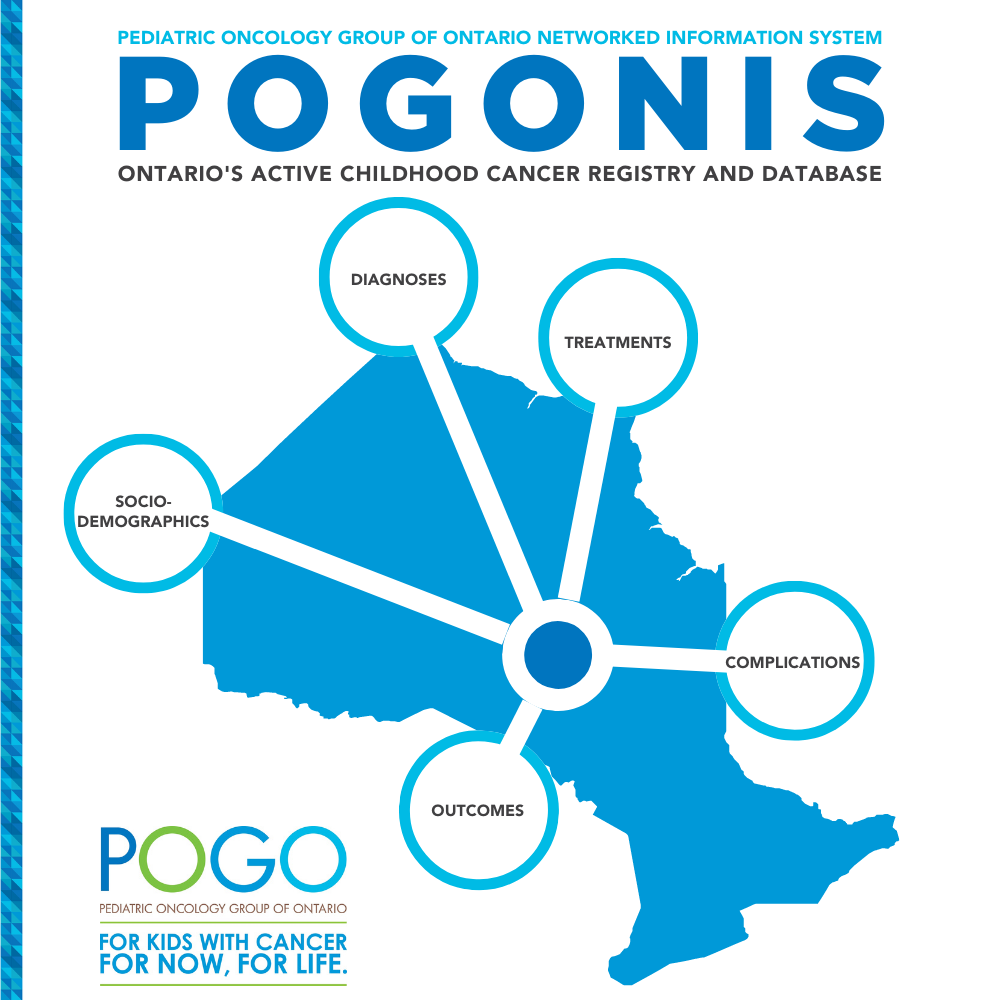
POGONIS (Pediatric Oncology Group of Ontario Networked Information System) is an active, population-based database of all children and adolescents with cancer, diagnosed and/or treated in a specialized childhood cancer program in Ontario.
Our innovative database contains detailed clinical information and specifics about children’s diagnosis, treatment, complications and long-term outcomes. Read our statement of purpose to learn more about how we protect and use patient data.
POGONIS is actively used by POGO and our partners for cancer surveillance, research, decision-making, system and program planning and evaluation, and policy advice.

The Benefits of POGONIS to Our Hospital Partners
Each of the five specialized childhood cancer programs across Ontario feeds data on the children they care for into POGONIS and are able to use POGONIS to track their own statistics regarding patient volumes and service output. In Ontario, the generation and maintenance of POGONIS, POGO’s active population-based registry, makes it a source of reliable, validated data used to monitor:
- The incidence and prevalence of childhood cancer
- The need for cancer care for children and youth
- The nature and specifics of childhood cancer treatment
- Patient outcomes
- Long-term effects of childhood cancer and its treatment
- Health service utilization and system performance
Using POGONIS for Program Planning Across the Childhood Cancer System
POGONIS enables knowledge transfer and facilitates the data-driven development of best practices and quality improvements for the childhood cancer care system. Using POGONIS, we can precisely estimate and accurately project the incidence of childhood cancer in Ontario; plan new initiatives and determine staffing requirements to provide care in strategic locations across the province; and share information with the Ministry of Health and other planning bodies. The value and utility of POGONIS data contribute greatly to our realization of the childhood cancer care system goals and objectives established in the Childhood Cancer Care Plan.
How POGONIS Contributes to Research
The POGO childhood cancer registry, POGONIS, is an unparalleled resource for pediatric cancer research. The results of projects generated from POGO’s registry will have immediate and lasting impact on the care of Ontario’s children with cancer, as well as that of children around the globe – both those who are newly diagnosed and the growing population of long-term survivors.
– Dr. Paul Nathan, Pediatric Oncologist, The Hospital for Sick Children
POGONIS is the engine driving childhood cancer research activity by POGO and our external research partners. It provides essential data for research studies, particularly population-based research. As POGONIS has captured data on a unique population over a long period of time, POGO and other researchers can conduct research with a breadth and scope that is unparalleled elsewhere. What we’ve learned about childhood cancer care in Ontario is applicable to health systems across Canada and around the world.
POGONIS Data Nomenclature
The POGONIS Nomenclature and Diagnostic Classification system is mapped to the International Classification of Childhood Cancer (ICCC) system and the International Classification of Diseases for Oncology, 3rd Edition (ICD-O-3). This facilitates comparison with other national and international childhood cancer databases.
We welcome requests for the use of the childhood cancer data in POGONIS and our other POGO personal health information (PHI) data holdings for analysis and/or research purposes.
POGONIS Statement of Purpose
Research & Data
Supportive Care and Guidelines
The POGO Networked Information System (POGONIS) is an active, population-based database of all children and adolescents with cancer diagnosed and/or treated in a specialized childhood cancer program in Ontario. POGO collects and retains information in POGONIS under the legislative authority of our Prescribed Entity designation through the Personal Health Information Protection Act, 2004 (PHIPA).
Statement of Purpose
What is the purpose of the data holding?
In Ontario, POGONIS is a source of reliable, validated data used to monitor:
- The incidence and prevalence of childhood and adolescent cancer
- The need for cancer care for children and youth
- The nature and specifics of childhood cancer treatment
- Patient outcomes
- Long-term effects of childhood cancer and its treatment and
- Health service utilization, system quality indicators and program evaluation.
POGONIS also produces diagnosis and treatment summaries for survivors and enables the assembly of cohorts for investigation in multiple pediatric cancer analysis and research projects.
What PHI is contained in the data holding?
The patient personal health information (PHI) contained in the data holding includes:
- Name
- Date of birth
- Sex
- Postal code
- Health card number
- Hospital chart numbers
What is the source of the PHI?
The source of the PHI is the cancer patient’s hospital chart at the specialized childhood cancer program.
Why is PHI needed in relation to the identified purpose?
PHI is needed because POGONIS is the source of population (Ontario) data that is validated with source data (the patient chart). The PHI is required to produce diagnosis and treatment summaries for survivors and to enable linkage of the data with other administrative datasets necessary to facilitate analysis and research.
Why won’t de-identified and/or aggregate information serve the identified purpose?
De-identified and/or aggregate information will not serve the identified purposes because POGONIS is a patient-level, point-of-care database.
Contact Us
For any questions or concerns about POGONIS, please contact pogodatateam@pogo.ca.
We welcome requests for the use of the data in POGONIS and other POGO PHI data holdings for analysis and/or research purposes.
POGO values privacy and protects the personal health information (PHI) of children and youth with cancer, survivors of childhood cancers and their families.
POGO Satellite Program Database
Research & Data
Supportive Care and Guidelines
Description
POGO’s Provincial Pediatric Oncology Satellite Program transfers aspects of a child’s care, for eligible patients, to POGO Satellite Clinics in community hospitals closer to home. We collect and retain information in our POGO Satellite Program Database, which we maintain under the legislative authority of our Prescribed Entity designation through the Personal Health Information Protection Act, 2004 (PHIPA).
Statement of Purpose
What is the purpose of the data holding?
The purpose of this database is to securely store patient, visit and treatment information for POGO Satellite Program patients to support the transfer of care from the specialized childhood cancer program to the POGO Satellite Clinic; inform program planning and evaluation; conduct analysis and reporting for the Ministry of Health, other system partners and stakeholders; and for health system planning purposes. Data captured in the data holding are both linked and compared with POGO’s childhood cancer database, POGONIS, to ensure accuracy, facilitate additional analysis and support potential research endeavours.
What PHI is contained in the data holding?
The patient personal health information (PHI) contained in the data holding includes:
- First name, middle name and surname
- Date of birth
- Hospital-assigned medical record number (MRN)
- Date of death (if applicable)
What is the source of the PHI?
Local hospital-specific medical records are the source of PHI for the data holding and the information is inputted into the database by POGO Satellite Clinic Nurses.
Why is PHI needed in relation to the identified purpose?
PHI is required for the purposes of administering the program, enabling program planning, evaluation and improvement and verifying the accuracy of the POGONIS Registration ID for analysis and research through linkages.
The specialized childhood cancer programs search within the data holding by inputting one or more PHI data elements to identify whether the patient has been registered in POGONIS. Once a patient has been registered in POGONIS, the patient can be referred to one or more POGO Satellite Clinics. Once referred, the POGO Satellite Clinic(s) can access the patient’s record and input patient PHI data related to patient encounters.
The POGO Satellite Clinics may input a patient’s hospital-specific MRN and date of death (if applicable) to ensure consistency of the data holding with the local medical record.
Why won’t de-identified and/or aggregate information serve the identified purpose?
De-identified and/or aggregate information will not serve the identified purposes because:
- It cannot verify the accuracy of the POGONIS Registration ID which is necessary to facilitate analysis and research using linkages and
- The POGO Satellite Program Database is a patient-level, point-of-care database.
Contact Us
For any questions or concerns about the POGO Satellite Program Database, please contact satellite@pogo.ca.
We welcome requests for the use of the data in the POGO Satellite Program Database and other POGO PHI data holdings for analysis and/or research purposes.
POGO values privacy and protects the personal health information (PHI) of children and youth with cancer, survivors of childhood cancers and their families.

POGO Atlas of Childhood Cancer

Research & Data
Supportive Care and Guidelines
Atlas of Childhood Cancer in Ontario, 1985-2004
Greenberg ML, Barnett H, Williams J. January 2015
ISBN Print Version: 978-0-9939255-0-4
ISBN Online Version: 978-0-9939255-1-1
The first-ever Atlas of Childhood Cancer in Ontario is an in-depth, unique, population-based account of cancer in children and adolescents during a 20-year period. It provides a comprehensive overview of the incidence, survival and health care utilization of childhood cancer in Ontario.
2018 POGO Surveillance Report
Research & Data
Supportive Care and Guidelines
Review the most recent edition of this report here
Childhood Cancer in Ontario 1986–2015: A Surveillance Report from the Pediatric Oncology Group of Ontario describes the burden of cancer in children, aged 0 to 14 years, in Ontario, over a 30-year period, using data from POGONIS. The report focuses on the incidence of childhood cancer in Ontario, mortality and survival in the population. In addition, for the first time, the prevalence of childhood cancer is estimated for the Ontario population.
The report supports service delivery planning, policy development and research, with the ultimate goal of improving the well-being of children with cancer, survivors of childhood cancer and their families.
Key Findings
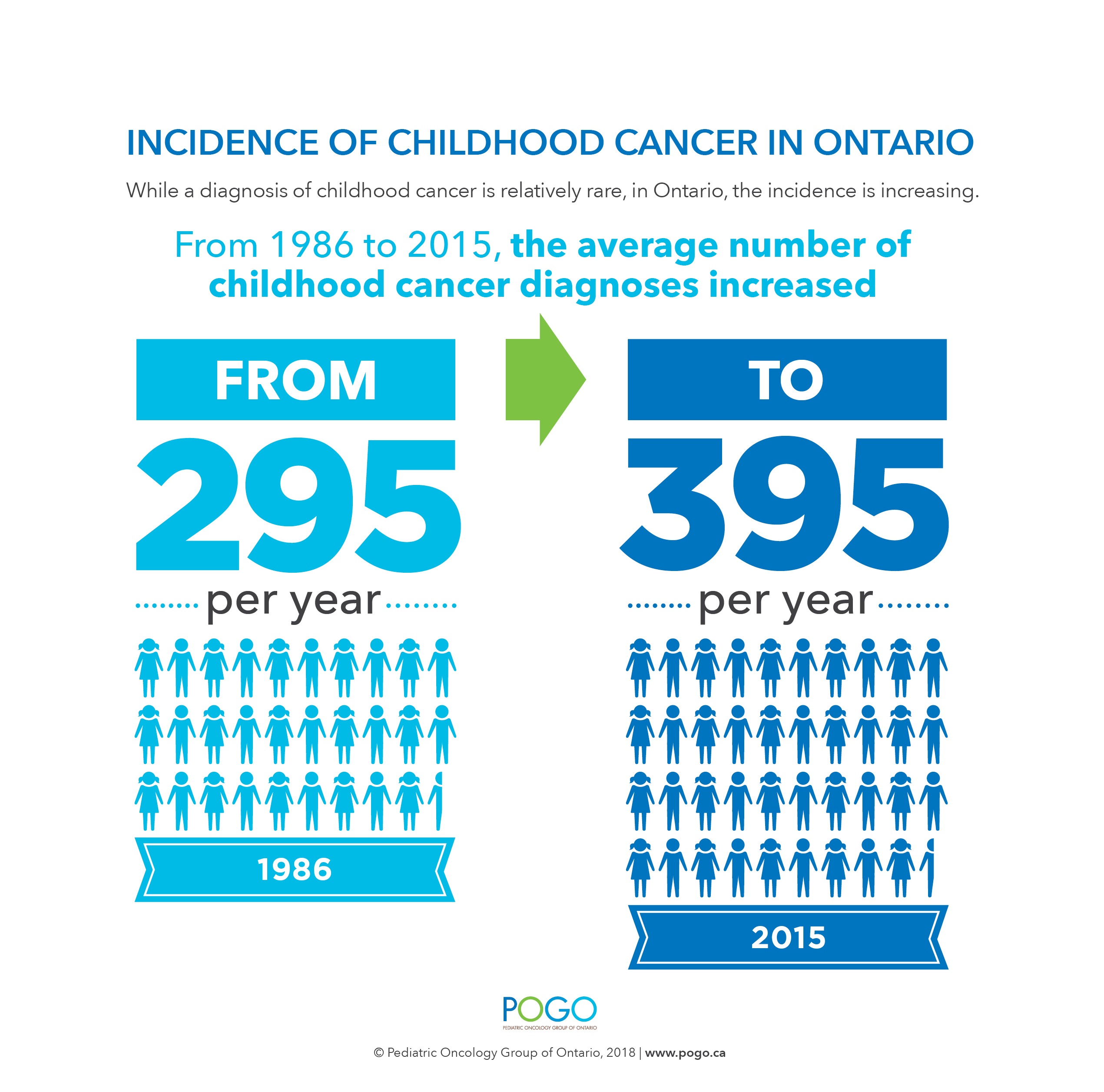
Incidence of Childhood Cancer in Ontario
- Childhood cancer is relatively rare – accounting for <1% of all new cancers in Ontario.
- The incidence of childhood cancer in Ontario is increasing by approximately 1% per year over the 30-year period.
- An average of 396 cases were diagnosed per year during the most recent 5-year period (2011–2015).
- Incidence rates fluctuate year over year, at times dramatically. Variations in the incidence of childhood cancer in Ontario have large impacts on service delivery and planning, given the high intensity of childhood cancer care.
- The most common types of new cases of childhood cancer were leukemias (50.2 per million), CNS tumours (37.8 per million) and lymphomas (18.7 per million).
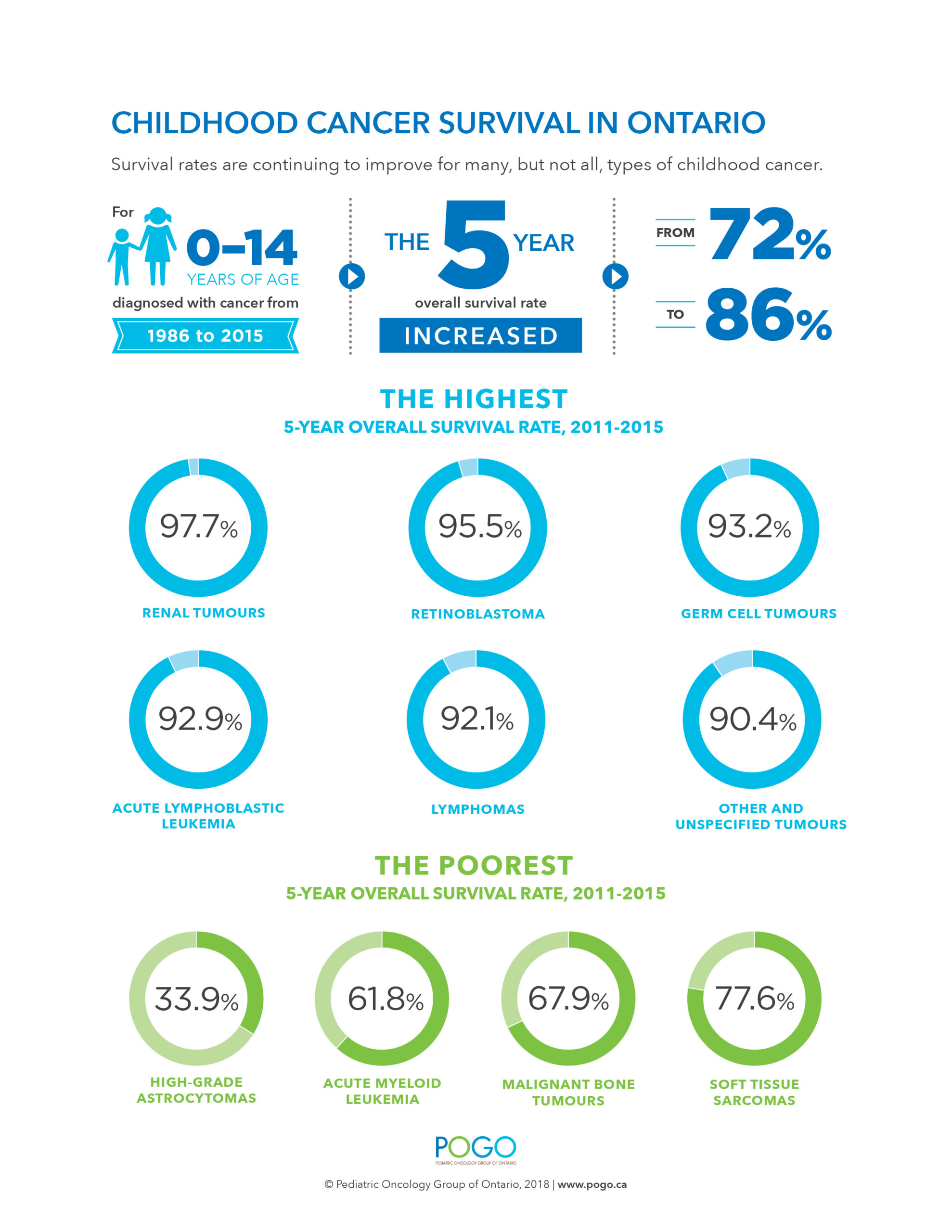
Childhood Cancer Mortality and Survival in Ontario
- With research leading to new therapies and better outcomes, Ontario’s children are living longer.
- Ontario has experienced a 13% increase in 5-year overall survival, increasing from 72.4% in 1986 to 85.5% in 2015.
- Survival rates are continuing to improve for many, but not all types of childhood cancer. Childhood cancer survival rates differ by age and cancer type.
- Mortality due to childhood cancer has remained stable over the past 25 years in Ontario and remains the most common cause of disease-related mortality among children in Canada over the age of one year.
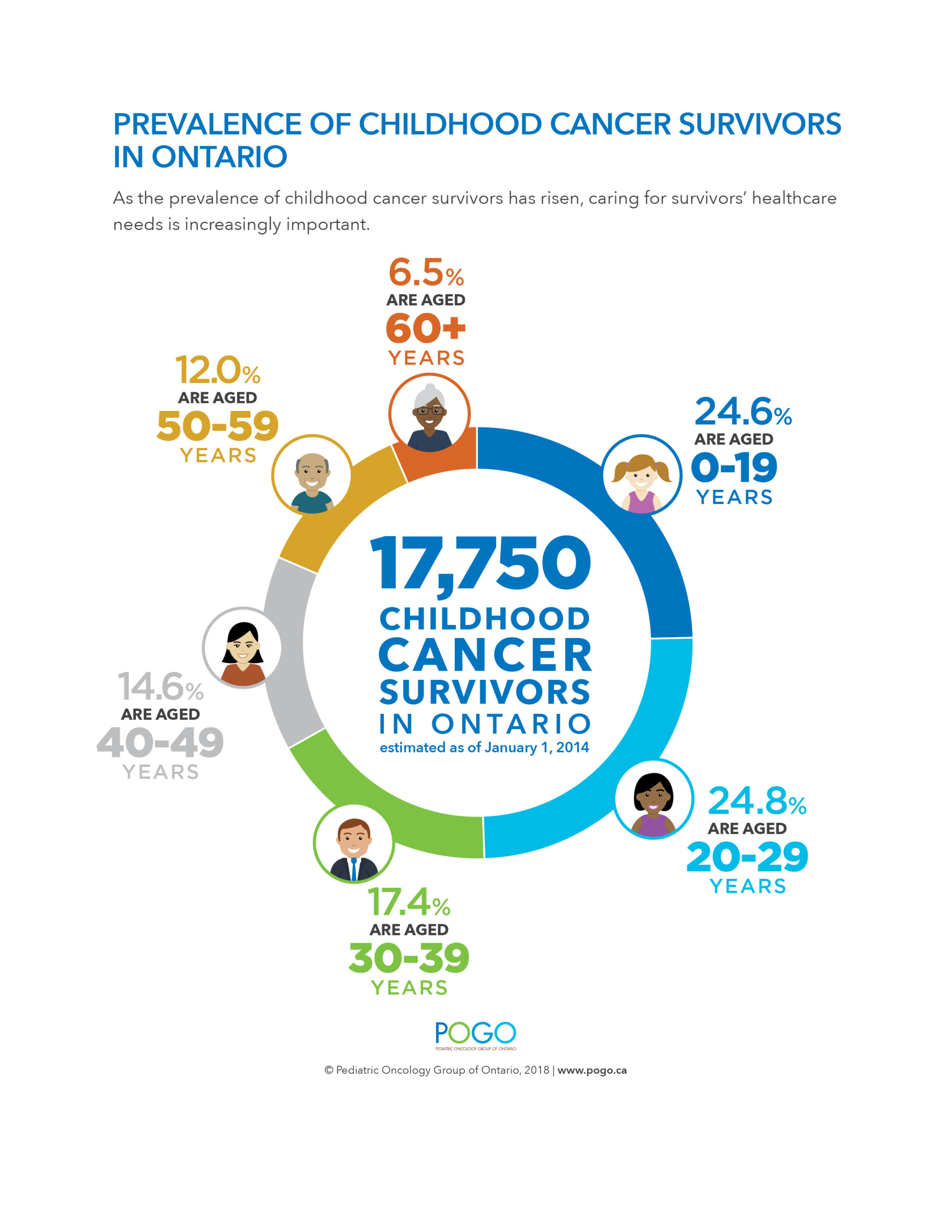
Prevalence of Childhood Cancer Survivors in Ontario
- The prevalence of childhood cancer survivors has risen steadily, due to the increasing incidence of childhood cancer, combined with marked improvements in survival over the last few decades.
- This means that there are an additional 20% of childhood cancer survivors living in Ontario today compared to eight years ago – increasing from 14,400 in 2007 to 17,750 in 2014.
- Over time, an increasing proportion of childhood cancer survivors will be adults – accounting for 75% of the total prevalence in 2014.
- Caring for survivors of childhood cancer is increasingly important given the growing population and increased healthcare needs that are associated with late effects of treatment.
Supplementary Resources
PowerPoint Slides (PPT)
The following PowerPoint slides are available for download, pre-populated with all of the figures and data tables from the report.
Infographics (PDF)
Infographics related to incidence, survival and prevalence of childhood cancer are available.
Related Resources
Contact Us
For more information about this report, please download the Full Report or contact: info@pogo.ca
Request additional data or learn more about POGO’s childhood cancer registry, POGONIS.
POGO School and Work Transitions Program Database
Research & Data
Supportive Care and Guidelines
Description
The POGO School and Work Transitions Program Database contains demographic information on childhood cancer survivors who need assistance in transitioning to post-secondary education or the workforce. It is a consent-based data holding wherein clients provide consent for their information to be collected and used in the data holding.
Statement of Purpose
What is the purpose of the data holding?
The purpose of this database is for reporting academic or vocational outcomes to the Ministry of Education. The data collected will be used for program evaluation, retrospective study and longitudinal study in the future. The data holding contains the electronic client files that are maintained throughout the counselling process. Data captured in the data holding is both linked and compared with POGO’s childhood cancer database, POGONIS, to ensure accuracy, facilitate additional analysis and support potential research endeavours.
What PHI is contained in the data holding?
The client personal health information (PHI) contained in the data holding includes:
- Name
- Address
- Date of birth
- Telephone number and email address
- Cancer diagnosis
- Date of cancer diagnosis
- Cancer treatment
- Health documents (e.g., medical letters, neuropsychological assessments)
- Workplace or school documents (e.g., accommodation letters)
- Educational attainment and vocational goals
What is the source of the PHI?
Clients or parents/caregivers provide consent for the client’s PHI to be collected and entered into the data holding by POGO School and Work Transitions Counsellors at our hospital partners where POGO School and Work Transitions Program services are provided.
Why is PHI needed in relation to the identified purpose?
POGO School and Work Transitions Counsellors must accurately identify each client to deliver, record and track targeted counselling services. In addition to collecting and using PHI to deliver services, the program collects and analyzes data to monitor its impact and plan future services. PHI is also required to verify the accuracy of the POGONIS Registration ID for analysis and research through linkages.
Why won’t de-identified and/or aggregate information serve the identified purpose?
De-identified and/or aggregate information will not serve the identified purposes because:
- It cannot verify the accuracy of the POGONIS Registration ID which is necessary to facilitate analysis and research using linkages and
- The POGO Transitions Program Database is a client-level database for a service delivery program.
Contact Us
For any questions or concerns about the POGO School and Work Transitions Program Database, please contact transitions@pogo.ca.
We welcome requests for the use of the data in the POGO School and Work Transitions Program Database and other POGO PHI data holdings for analysis and/or research purposes.
POGO values privacy and protects the personal health information (PHI) of children and youth with cancer, survivors of childhood cancers and their families.
POGO Interlink Nursing Program Database
Research & Data
Supportive Care and Guidelines
Description
The POGO Interlink Nursing Program offers specialized oncology support to families across hospital, home and community environments in Ontario. We collect and retain your patient information in our POGO Interlink Nursing Program Database, which we maintain under the legislative authority of our Prescribed Entity designation through the Personal Health Information Protection Act, 2004 (PHIPA).
Statement of Purpose
What is the purpose of the data holding?
The purpose of this data holding is to securely maintain records of patient admissions and discharges, home visits, school meetings and other program services delivered by the POGO Interlink Nurses. Personal health information (PHI) collected in the data holding is both linked and compared with POGO’s childhood cancer database, POGONIS, to ensure accuracy, facilitate additional analysis and support potential research endeavours.
What PHI is contained in the data holding?
The patient personal health information (PHI) contained in the data holding includes:
- First, middle and last name
- Date of birth
- Gender
- Medical record number (MRN)
What is the source of the PHI?
Local hospital-specific medical records at hospital partners where POGO Interlink Nursing Program services are offered are the sources of PHI for the data holding and the information is securely submitted to POGO by POGO Interlink Nurses.
Why is PHI needed in relation to the identified purpose?
PHI is required for program planning and evaluation; to enable analysis and reporting to the Ministry of Health, other system partners and stakeholders; and verifying the accuracy of the POGONIS Registration ID for analysis and research through linkages.
Why won’t de-identified and/or aggregate information serve the identified purpose?
De-identified and/or aggregate information will not serve the identified purposes because:
- It cannot verify the accuracy of the POGONIS Registration ID which is necessary to facilitate analysis and research using linkages and
- The POGO Interlink Nursing Program Database is a patient-level, point-of-care database for a service delivery program.
Contact Us
For any questions or concerns about the POGO Interlink Nursing Program Database, please contact interlink@pogo.ca.
We welcome requests for the use of the data in the POGO Interlink Nursing Program Database and other POGO PHI data holdings for analysis and/or research purposes.
POGO values privacy and protects the personal health information (PHI) of children and youth with cancer, survivors of childhood cancers and their families.
POGO Financial Assistance Program Database
Research & Data
Supportive Care and Guidelines
Description
The POGO Financial Assistance Program, funded entirely by private-sector donations, supports families through the enormously financially challenging period of a child’s active cancer treatment. The POGO Financial Assistance Program Database is a consent-based data holding wherein patients and families provide consent for their information to be collected and used in the data holding.
Statement of Purpose
What is the purpose of the data holding?
The purpose of this data holding is to securely store, manage and process family registration, direct deposit and claim information to administer the program and enable program planning, evaluation and improvement. Data captured in the data holding is both linked and compared with POGO’s childhood cancer database, POGONIS, to ensure accuracy, facilitate additional analysis and support potential research endeavours.
What PHI is contained in the data holding?
The patient and family personal health information (PHI) contained in the data holding includes:
- Patient first and last name
- Patient date of birth
- Patient address, city and postal code
- Patient date of diagnosis
- Patient date of relapse if applicable
- Main hospital where family is receiving treatment
- Primary family contact first and last name
- Primary family contact email address
- Alternate caregiver first and last name
- Primary family contact or alternate caregiver banking information (bank name, transit number and bank account number)
What is the source of the PHI?
Patients and families provide consent for their PHI to be collected and entered into the POGO Financial Assistance Program Database by Social Workers, POGO Interlink Nurses and Resource Navigators in the specialized childhood cancer programs at our tertiary centre hospital partners.
Why is PHI needed in relation to the identified purpose?
PHI is required to match patient information for the purposes of administering the program, enabling program planning, evaluation and improvement and verifying the accuracy of the POGONIS Registration ID for analysis and research through linkages.
- Patient first and last name and date of birth: Enables connection to POGONIS
- Patient address, city and postal code: To issue cheques to the family when direct deposit is not available (i.e., religious and/or cultural beliefs)
- Patient date of diagnosis/date of relapse: Ensures financial assistance is issued to families on active treatment in accordance with program eligibility criteria
- Primary family contact first and last name: To address correspondence and ensure cheque is issued to the correct person
- Alternate caregiver first and last name: For compassionate and paid hotel access
- Banking information: Ensures claims/funds are issued to the correct account
Where POGO uses email for program administration and service delivery purposes, only the primary family contact or alternate caregiver is identified. The primary family contact and alternate caregiver first and last names are used when booking a hotel for the compassionate hotel program. The primary family contact and alternate caregiver need to give consent for their name to be shared with the hotel. The patient’s name is not provided to the hotel.
When healthcare providers are submitting claims, they may not know the Family ID and request confirmation through POGO. In such scenarios, many of the PHI variables are used to ensure the correct family is identified and the correct Family ID is provided for accurate processing of claims.
Why won’t de-identified and/or aggregate information serve the identified purpose?
De-identified and/or aggregate information will not serve the identified purposes because:
- It negates the ability to provide financial assistance as the family’s identity would not be known and claimed funds could not be issued
- It cannot verify the accuracy of the POGONIS Registration ID which is necessary to facilitate analysis and research using linkages and
- The POGO Financial Assistance Program Database is a client-level database for a service delivery program.
Contact Us
For any questions or concerns about the POGO Financial Assistance Program Database, please contact financialassistance@pogo.ca.
We welcome requests for the use of the data in the POGO Financial Assistance Program Database and other POGO PHI data holdings for analysis and/or research purposes.
POGO values privacy and protects the personal health information (PHI) of children and youth with cancer, survivors of childhood cancers and their families.
Data Anatomy
Research & Data
Supportive Care and Guidelines
POGONIS is POGO’s active registry and database on childhood cancer in Ontario. It is a rich source of data, which are available to inform childhood cancer system policy and planning and for research purposes.
POGONIS Data Dictionary
For a copy of the POGONIS Data Dictionary Manual, please contact the POGO Data team.
Disease Diagnosis Overview

Patient Demographics
- POGO Diagnosis Code
- Hospital ID
- Health Card Number
- Date of birth
- Postal code (at diagnosis)
- Patient Registration ID
- Race
- Sex
- Limited Registry
- Out of Country
- Out of Province
- Aged 18 years at diagnosis
- Etc.
Disease Diagnosis
- POGO Diagnosis Code
- Diagnosis
- Date of definitive diagnostic procedure
- Pathologically confirmed diagnosis and date
- Diagnostic code
- Method of diagnosis
- ICD-O M Code
- Benign/NIB/malignant
- Histology/morphology
- First or subsequent primaries
- Biological markers
- Revised diagnosis and date
- PET
- Diagnosis History: Patient
- Main complaint
- Date of onset
- Date of first health care contact
- First health care contact professional
- First health care contact setting
- Date of initial diagnostic procedure
- Diagnosing institution
- Referring physician: Name and speciality
- Responsible physician
- Protocol/clinical trial
- Enrolment
- Height/weight/BSA
- Treatment start/end date
- Main complaint
- Medical History: Patient
- Predisposing conditions
- Disease
- Stage code
- Primary site (T code)
- Site description
- Extent of disease
- Relapse site and date
- Metastatic site(s)
- Minimal residual disease
- True disease conversion
- WBC (ALL)
POGONIS Data Elements

Death Record
- Date
- Cause
- Location
- Autopsy
Medical Treatments
- POGO Centre
- POGO Code
- Protocol/clinical trial
- Radiation
- Cancer surgery
- Systemic therapy
- Chemotherapy
- Biomodifiers
- HSCT/cellular therapy
- Secondary surgery
- Other supportive care
- Active follow-up treatment
- Complications of treatment
- Fever and neutropenia
- Palliative treatment
- Major organ system complications
- Shared care: Type and location
Treatment Service Record
- POGO Code
- POGO Centre health service utilization
- Treatment/service type
- Treatment/service: Start/end/report year
- Treatment/service institution
- Treatment/service provider: Staff/discipline/non-professional
- Number of events/treatment units
- Transfer out
POGO Satellite Clinic Program
- Name of POGO Satellite Clinic
Late Effects
- POGO Pediatric and Adult AfterCare Clinic
- POGO Code
- Late effects by system
- Neurocognitive/neuropsychological assessment: Yes/no and date