Scholarship Applications After Cancer: Hugh’s Practical Advice for Students
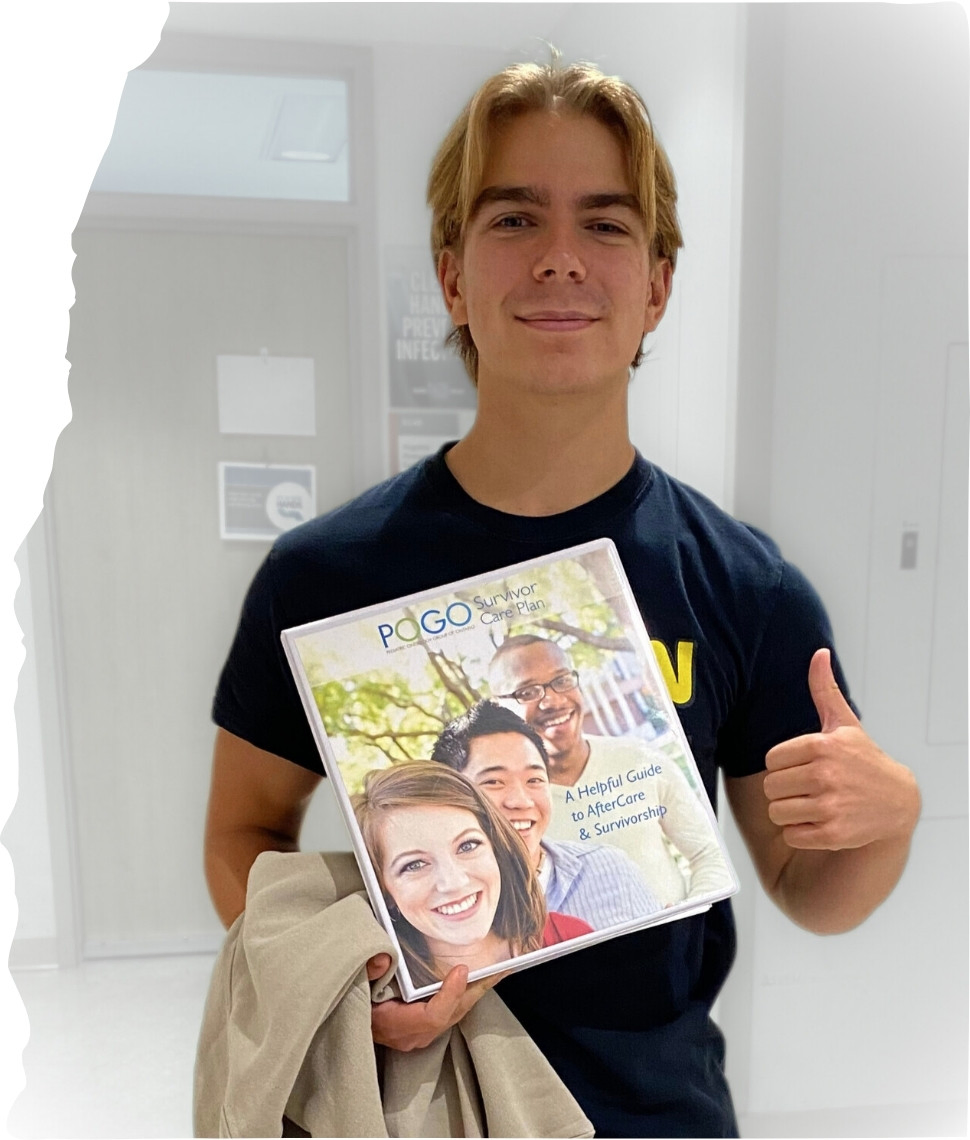
When Hugh, a brain tumour survivor, was applying to postsecondary school last year, he learned about scholarships from his POGO School and Work Transitions Counsellor, me!
We worked on the applications together and recently talked about the process and any advice he had for this year’s scholarship applicants.
“First find out which scholarships you qualify for,” Hugh says. “Some are looking for a specific diagnosis or disability while others are looking for things like people with lots of volunteer experience.”
It is important to read the application instructions carefully because they’re all different. If reading for detail is not your thing, ask someone to help.
Each scholarship asks for some kind of “Personal Statement” about your cancer journey and what your plans are for school and the future. After putting together a draft, Hugh sent his statements to me to look over and edit.
You’ll also need a letter with proof of your diagnosis, which is in your AfterCare Binder, or you can ask your medical team.
Some scholarships may also ask for a reference letter. “Each scholarship had different requirements, so it wasn’t one and done,” Hugh says. “Giving yourself lead time is a good idea: you have to ask for the reference, sometimes you have to provide them with background information about who you are and your relationship to them, and then you have to give them time to write it.”
Hugh found this time to be a bit overwhelming because so many things were happening at one time—deciding which school to go to, getting his accommodations set up, course selection, figuring out housing, all the while waiting to hear if he’d been awarded a scholarship.
Last summer, Hugh was happy to hear he’d been awarded not only one, but two scholarships for childhood cancer survivors!
Once he got the news, he still had a lot of work to do: send his social insurance number, write a thank you letter, provide a quote for each of their websites, figure out which scholarship sent the money to his school, and which sent it right to him. He also had never received a cheque before and had to figure out what to do with it!
Hugh recommends leaning on your support system to help you navigate this process. “I talked to family, friends who were already in postsecondary, my teachers including my special education resource teacher (SERT), the school guidance counsellor, and of course, my friendly neighbourhood School and Work Transitions Counsellor.”
This story was written by Helen Antoniades, POGO Counsellor, for the spring 2026 issue of the POGO School and Work Transitions Program newsletter.

Turn Your Childhood Cancer Experience into Support for Others
POGO School and Work Transitions Counsellors play a critical role in ensuring childhood cancer survivors have care specific to their needs and that they get the most from hospital and community supports to improve their overall well-being. Their strong relationships with community partners go a long way in strengthening the support POGO Counsellors provide.
Every day, POGO Counsellors meet with childhood cancer survivors and family members who carry a depth of wisdom, resilience, and compassion that can make a profound difference for someone who is just beginning or feeling alone in their own journey. CancerConnection.ca is an online peer support community offered by the Canadian Cancer Society. It is a safe place for people with cancer, and their loved ones, to connect, learn, and share their experiences.
As a volunteer facilitator in CancerConnection.ca, you’ll have the opportunity to share your story, offer support, and connect with others who truly understand. Many volunteers tell us that giving back not only helps others—it helps them reflect, heal, and feel part of something bigger.
Your voice matters. Your experience matters. And your presence could be exactly what someone else needs to feel less alone.
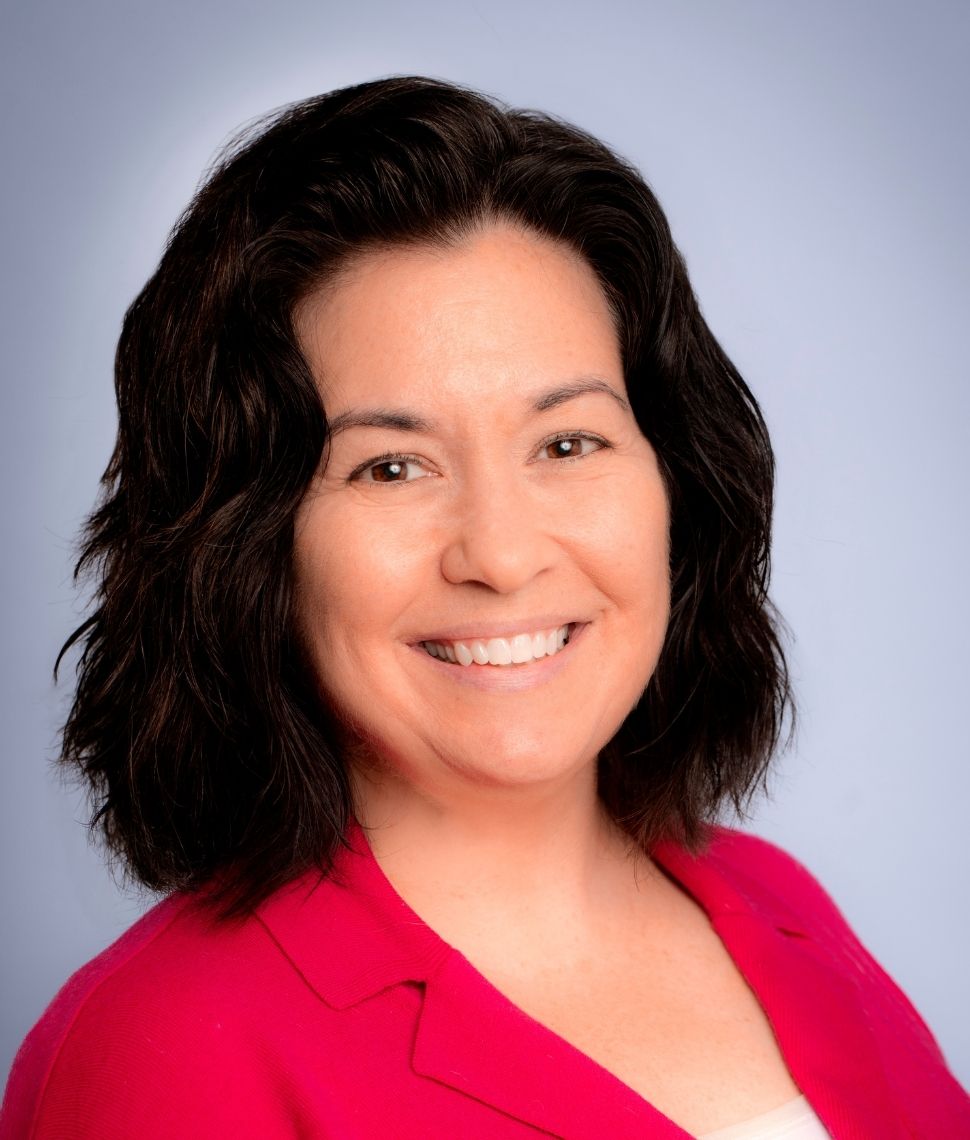
If this speaks to you, please contact Barb Williams, Manager, POGO School and Work Transitions Program, for more information.
If you don’t want to be a peer facilitator, that’s ok! You can still be a valuable part of the online community by joining the newly created Childhood Cancer Lived-Experience group.
This story was written for the spring 2026 issue of the POGO School and Work Transitions Program newsletter.
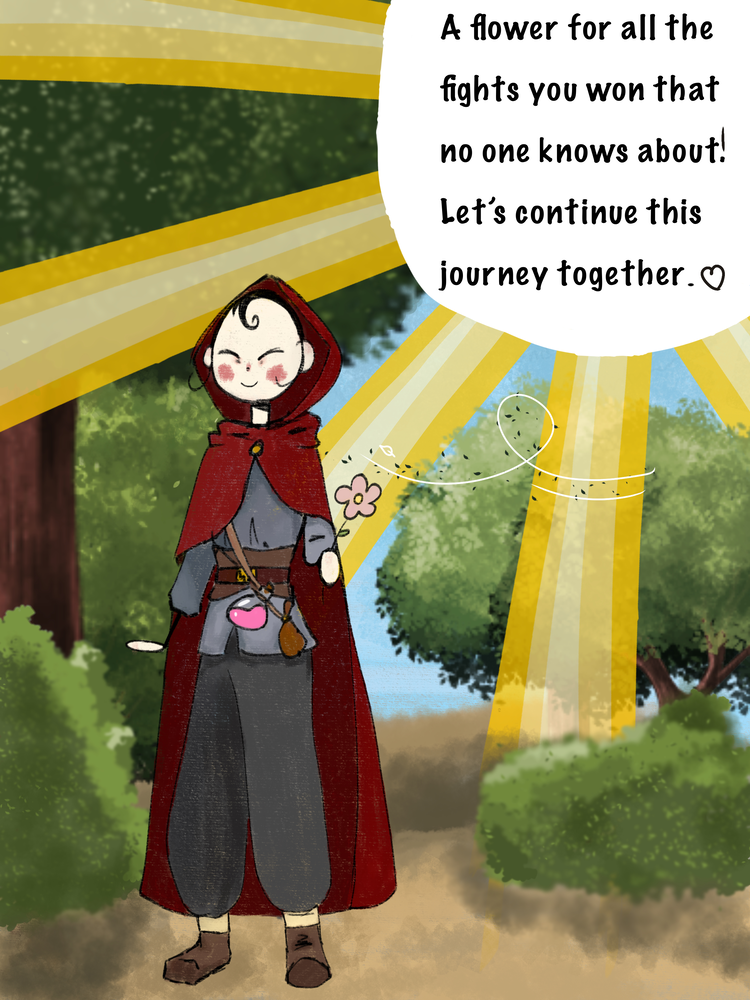
Creative Corner with Sarah
“Art makes me happy ‘cause it makes me feel freer and more 'in control' of my life!”
Sarah Eid
Diagnosis: Ewings Sarcoma
Tools: IPad, stylus, Sketchbook & pencil (for sketch)
App: Ibispaint
Time: ~5h
Creator/artist: All made by me!
Since I was a kid, I always loved drawing things (especially characters and outfits). Drawing always helped me feel better and get things out of my mind. Throughout elementary to high school, it always brought me peace.
When I first got diagnosed, I felt like I had nothing to do and that everything just stopped.That’s when I realized that all this free time (whether it was during treatment or waiting for results) was the perfect opportunity for me to enhance myself doing what I loved most and attempt new things in it (I started practicing more with watercolour and digital art!). It helped me get through a lot because it made me feel capable of doing the things I love and create a peaceful world for me that had all my stories and characters together without thinking much about what’s happening in the real world.
I felt proud and somewhat happy because I was getting better and expanding my abilities in something I always loved but rarely had time for. It made me feel like I was still kinda “me” even after all these changes and events . Art makes me happy ‘cause it makes me feel freer and more “in control” of my life! 😁
Creative Corner is a feature of the POGO School and Work Transitions Program newsletter that showcases the many creative strategies childhood cancer survivors use to cope, heal, and navigate their journeys, shared in their own voices.
The Privilege of a Heartbeat: A Teen Survivor Learns to Live Fully After Cancer
In today’s world, a lot of people (myself included) don’t seem to recognize just how important your health is. Most people couldn’t imagine how much their life would change if they were suddenly told, out of the blue, that you’d be spending the better part of the next eight months in a hospital bed. It really sucks, right? Well, that’s how my 16th year on this earth went, yet surprisingly, I would never trade my life for another. Not only did this unexpected health event change my views on day-to-day life, it also gave me a positive outlook on my life, no matter the situation.
In 2024, a month before my birthday, I was ultimately diagnosed with ALCL lymphoma. For a couple of months leading up to my diagnosis I was bedridden, unable to walk or do anything without being in excruciating pain due to a yet undiagnosed tumour that caused a pressure fracture in my spine. I remember waking up from a nap in the hospital room to my mom crying and the doctor trying to comfort her. I remember thinking about every little thing that I took for granted in life and how lucky I was (and still am) just to be alive. What I realized is that everything other than a heartbeat is a privilege.
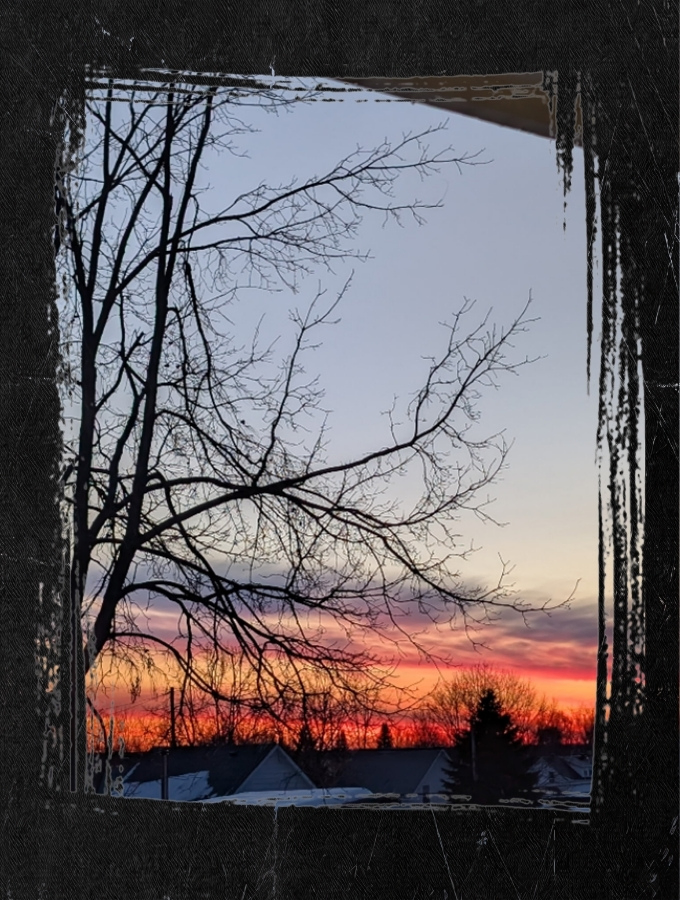
“Our life is worth a million planets so live like it”
– Childhood Cancer Survivor
Now without giving you a sob story about this, I’m just going to say one thing: IT REALLY SUCKED. What sucked, you ask? I’ll tell you, but I you may not be expecting the answer about what a now 17 year-old boy missed about his life. If I’m being honest, it for sure sucked that I couldn’t go out in big crowds, or go to parties, or travel. The time in the hospital really made me miss a lot, and yeah, all that fun stuff would have been nice, but here’s what I really missed:
- Feeling healthy and being strong enough to do day-to-day tasks like walk to the kitchen
- Being able to stomach my favourite foods
- Working out and staying active
- Being able to shower without a pic line in my arm
- Being able to think
Most importantly I missed feeling normal.
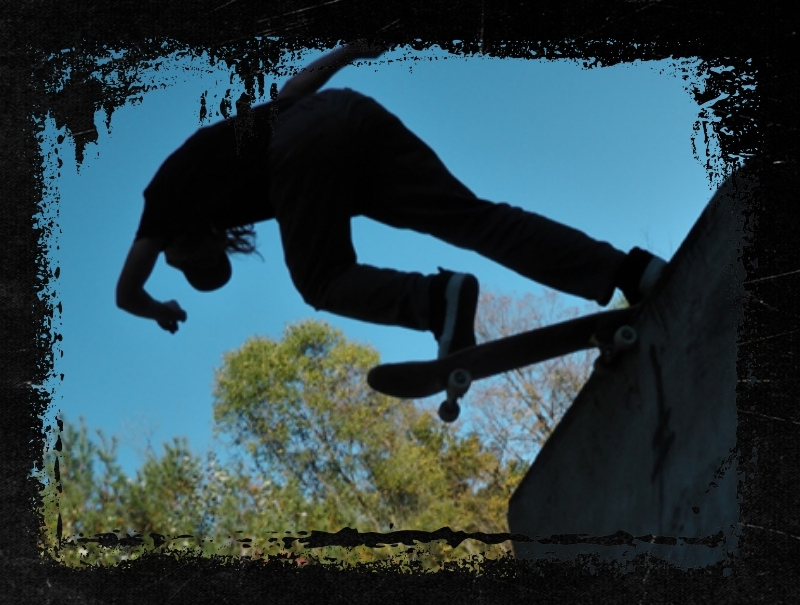
I have now been cancer-free since March 2025. It hasn’t been easy getting back to who I was, but feeling like I was a non-functioning member of society made me want to find my place. I now value my life like nothing else and have found hobbies I actually enjoy. Let me tell you, it feels absolutely amazing to have that smile back on my face. I finally get to be a real kid again and I am so grateful. Remember how I said your health is important? That includes protecting your body as well. Last October, I broke my elbow while skateboarding. I ended up having to be in a full arm cast for three months, putting me right back in the same situation of not being able to be productive or have fun. SO PLEASE be careful when you’re having fun and living every moment of your life to the fullest because you never know what the next chapter of your life will bring you.
Our life is worth a million planets so live like it. Instead of letting restrictions fully stop you from living, play a little game called “how far can I go?” Do not let restrictions put an end to your goals and hobbies because as long as you have a heartbeat, you should be grateful every morning you wake up.
This story was written by a childhood cancer survivor for the spring 2026 issue of the POGO School and Work Transitions Program newsletter.